
Why you need a SaaS management platform now


For many organizations, SaaS governance remains on the roadmap rather than a reality. IT teams are stretched thin, priorities compete for attention, and implementing a SaaS management platform often gets pushed to next quarter.
But every month governance is delayed, risk accumulates.
As SaaS environments continue to expand, organizations lose visibility into application usage, access permissions, license ownership, and security posture. Employees join, change roles, and leave the organization while access rights remain scattered across hundreds of applications. Shadow IT grows unchecked. Audit preparation becomes increasingly difficult. Compliance requirements become harder to satisfy.
The question is no longer whether your organization needs SaaS governance, it is how much risk your organization is willing to accept without it.
Read on to learn:
- The governance costs of inaction
- How a SaaS management platform helps organizations establish visibility, accountability, and control across their SaaS ecosystem
- Overall productivity improvements your IT team gets from using a SaaS management platform
- How adding automation muscle becomes a true force multiplier in user lifecycle management
- How starting now pays off fast
Take productivity to new heights
With an average of 106 SaaS apps, effective SaaS management is more important now than ever.
Thanks to countless, never-ending user lifecycle tasks needed for protecting the ever-growing expanse of sensitive data, the effort for managing it all is accelerating.
Every application introduces new users, permissions, data-sharing configurations, and security considerations. Without centralized oversight, organizations struggle to answer basic governance questions:
- Who has access to sensitive applications?
- Are users receiving the appropriate level of access?
- Which former employees still have active accounts?
- Where is company data being shared externally?
- Which applications create compliance or security risk?
A SaaS management platform provides the visibility and governance controls needed to answer these questions with confidence. By centralizing application management, organizations can enforce policies consistently, maintain accurate access records, and reduce operational and security risk.
Rather than relying on manual processes and spreadsheets, governance teams gain a system of record for SaaS access, ownership, and policy enforcement.
With proper user lifecycle management and security controls in place, organizations can then:
- Maximize operational efficiency
- Accelerate employee productivity
- Scale IT impact
To achieve these benefits, organizations across all industries and sizes now rely on SaaS management platforms – capable of automation and purpose-built for IT, of course.
But just how much does this crucial technology benefit?
Let’s first consider two important data points:
Such improvement results from getting the most out of a SaaS management platform. In fact, organizations that enjoy the highest levels of improved productivity automate routine tasks like user lifecycle management, as well as day-to-day operational tasks like app access requests or password/MFA resets to essentially create self-service portals for end users.
If your IT team faces these challenges, then, the sooner you adopt a SaaS management platform, the faster you benefit.
To convince you, we’ll go into how a SaaS management platform impacts user lifecycle management, a key SaaS management task.
Improve productivity with automated user lifecycle management – while boosting security
Of course, boosting productivity means saving time, which then translates to saving money.
Let’s look at how.
In BetterCloud research conducted in spring 2023, SaaS management platform users with a few hundred employees save about 1,700 hours – about 82% of a full-time team member – by automating user lifecycle management alone.
Of course, it’s important to remember that time spent for onboarding and offboarding varies based on the actual numbers of employees added and removed from corporate resources.
Thus, for a big company with thousands of employees, automating user lifecycle management will save that company many, many thousands of hours.
So now, time to examine the broader business case for a SaaS management platform.
Automating user lifecycle management delivers significant IT productivity gains
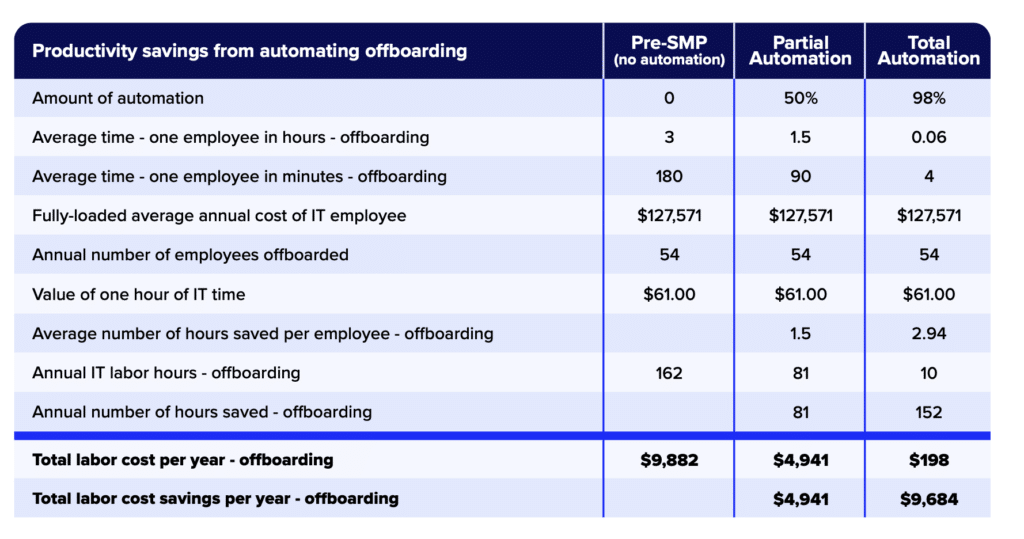
Let’s revisit the scenario of a company with approximately 300 employees. Specifically focusing on the offboarding process, let’s examine organizations that have already completed nearly all of it.
With 18% turnover, we assume that it takes 3 hours to offboard one employee, and over the course of a year, it requires 162 hours to complete the same, error-prone, boring tasks to offboard all departing users.
In conservative estimates of dollars and cents, an organization loses $10,000 worth of time in offboarding tasks that could be automated.
And that’s not all.
In many cases, IT must onboard every replacement for departed users. And that’s another $10,000 of valuable time lost to the same old, error-prone manual tasks.
Now, we’re up to a conservative estimate of $20,000 in time spent on onboarding and offboarding tasks that could be automated.
So, if your company struggles to provide Day 1 onboarding, find the right IT skills, or wants to provide a better IT employee experience, then automating using a SaaS management platform will provide big productivity gains.
How, then, does the business case change when adding other benefits?
SaaS license reclamation and security strengthens the business case
As part of performing the actual lifecycle management tasks, IT must reclaim and redeploy all SaaS licenses. After all, an asset is only productive when it’s in use.
In addition, in order to ensure maximum security, IT must perfectly perform all manual steps. However, nothing, except automation, guarantees a mistake-free offboarding.
SaaS license waste is too high.
By failing to completely offboard a former user, SaaS license waste is bound to occur.
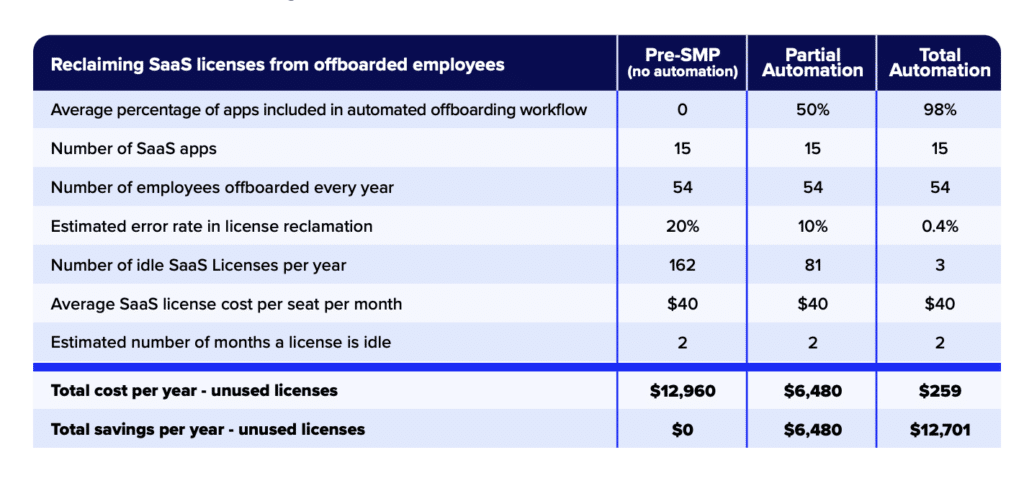
Unused, unproductive licenses are an enormous cost, and we’ll illustrate it with an example.
If you pay $40 per month of 162 dormant licenses, then in just two months, you’re losing nearly $13,000. Over the course of a year, left untouched, those license fees mount, needlessly costing you almost $80,000.
Once again, unproductive SaaS licenses highlight the need for a SaaS management platform.
Security risk reduction makes the business case a slam dunk.
One more cost heightens the need for a SaaS management platform now – security.
After all, despite the best intentions, manual offboarding is a haphazard process and mistakes are easily made. And when they happen, former users can retain access to your apps and data, introducing enormous risk until the mistake is uncovered and corrected.
Too many times, manual offboarding mistakes don’t surface until there’s a breach, and breaches are very, very expensive.
Using the 2019 Verizon Data Breach Investigation Report data, the average cost per breach per employee is $3,553.
To be conservative, let’s estimate that it’s only $353 in per employee breach costs. A single breach from erroneous manual offboarding will cost that company of 300 employees more than $100,000.
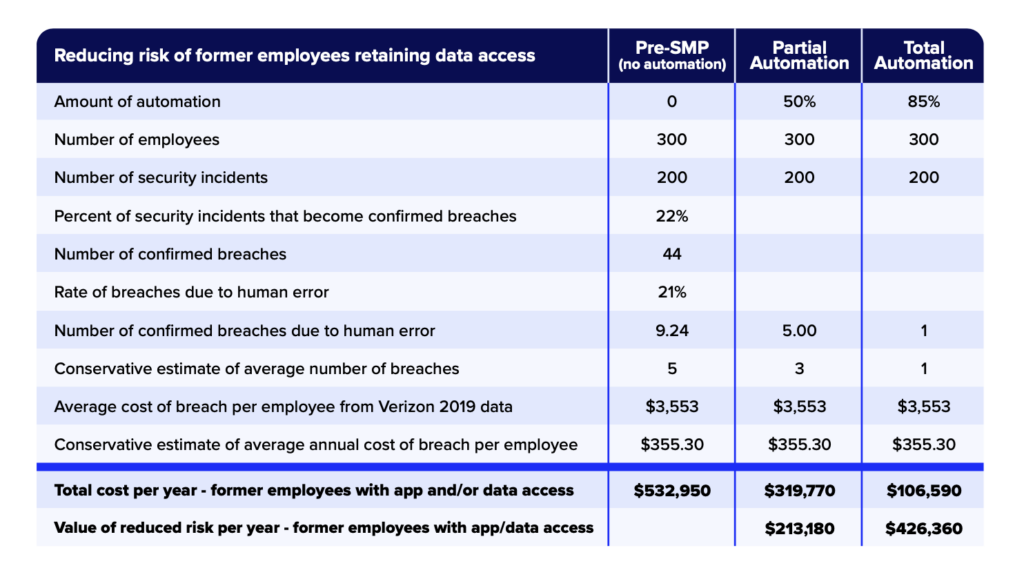
If we take that initial Verizon estimate of $3,553 into consideration, then a single breach could cost more than a million dollars.
Thus, for risk reduction alone, your company needs a SaaS management platform now.
But for user lifecycle management alone, total up the potential:
- IT productivity boost
- Elimination of unproductive SaaS licenses
- Risk reduction
You can’t help but conclude that the costs of delaying automating with a SaaS management platform are simply too high and impede productivity.
SaaS governance is no longer optional
As SaaS environments continue to grow, organizations face increasing pressure to maintain visibility, control, and accountability across their technology stack.
The cost of delaying governance extends far beyond operational inefficiency. It includes unmanaged access, compliance challenges, security exposure, software waste, and diminished organizational control.
A SaaS management platform enables organizations to establish governance at scale by automating lifecycle management, enforcing policies consistently, improving audit readiness, and reducing risk across the SaaS ecosystem.
The longer governance is delayed, the larger the governance gap becomes.
The question is no longer whether your organization needs SaaS governance. The question is whether you can afford to operate without it.
BetterCloud’s easy-use, no-code workflow engine offers IT teams a quick way to control your SaaS environment. To get you off and running, there’s also:
- An award-winning professional services team
- Free on-demand training videos
- Live training and workshops
For initial deployment, a dedicated team of implementation specialists provide hands-on, tailored services and best practices from hundreds of successful engagements.
Operating without a SaaS management platform has a high cost, and with BetterCloud’s quick deployment and time-to-value, waiting doesn’t make sense.
You need, and should, implement a SaaS management platform. Now. Request a demo.
FAQ’s
What is a SaaS management platform?
A SaaS management platform helps IT teams discover, manage, secure, and automate SaaS applications across an organization. It streamlines processes like onboarding, offboarding, license management, security enforcement, and application governance.
Why should organizations invest in a SaaS management platform now?
Delaying adoption can lead to wasted time, higher operational costs, increased SaaS license waste, and greater security risks. A SaaS management platform quickly improves productivity through automation and helps organizations scale IT operations more effectively.
How does a SaaS management platform improve IT productivity?
By automating repetitive tasks such as onboarding, offboarding, access requests, password resets, and MFA resets, IT teams can spend less time on manual work and focus on higher-value initiatives. BetterCloud research found that customers experience an average 49% increase in overall IT productivity.
What are the productivity benefits of automating user lifecycle management?
Automated user lifecycle management eliminates repetitive onboarding and offboarding tasks, reduces errors, and saves significant time. For organizations with a few hundred employees, automation can save approximately 1,700 hours annually.
What security risks are associated with manual offboarding?
Manual offboarding can result in missed steps, leaving former employees with access to company systems and sensitive data. These oversights increase the likelihood of security incidents, compliance violations, and costly breaches.
What business outcomes can organizations expect from a SaaS management platform?
Organizations can improve operational efficiency, accelerate employee productivity, strengthen security, reduce SaaS spend, enhance compliance, and increase the overall impact of their IT teams.

