AI Usage and its Impacts on Spending and Profitability Among Private SaaS Companies

In our 2026 annual survey of private SaaS companies*, we asked about AI usage in company operations and product. That lets us compare spending, profitability, and other metrics based on whether and how companies use AI. Below are the key takeaways:
- AI usage continues to increase in both operations and product, with the percentage of companies reporting no AI usage in either Operations or Product declining year over year.
- The majority of respondents are deploying AI to complement their core software offering; however, the percentage of companies with significant AI in the product increased year-over-year.
- At the margin, companies using AI in their operations are more likely to be breakeven or operating profitably than companies with no AI in operations.
- Overall, companies with $1-20 million in ARR that are using AI in operations and product are spending more on Marketing and R&D while spending less on G&A compared to similarly sized companies that are not using AI.
AI Adoption Year-over-Year
AI utilization among SaaS companies continues to increase. Over 82% of respondents are using some amount of AI in their day-to-day operations, up from 69% in the prior year’s survey. The percent of companies using at least some amount of AI in their product also increased from 76% to 83% over the same time period.
Among companies using AI in their product, the majority (65%) are using it as a complement to their existing core software, whereas 26% stated AI is a significant piece of their product and only 9% are entirely AI-based. The percentage of entirely AI-based companies is similar to 2025, but companies using a significant amount of AI in their product increased nearly 8 percentage points (from 18% to 26%). The takeaway is clear:
AI has been widely incorporated by SaaS companies, and its deployment has increased year-over-year.
We expect this trend to continue and, at the margin, for the number of significant or entirely-AI based product companies to increase. However, we believe this will take time to transpire and that there will remain room for companies to continue to successfully deploy AI in a more complementary role.
AI Adoption and Profitability
If the direction of travel for AI adoption appears clear, its impact on profitability is less certain.
Effective AI adoption gives SaaS companies a tool to unlock efficiencies and new opportunities in how they operate internally as well as build, execute and deploy their product. Simply stated, it offers the potential to create more output for a given input. With this, SaaS operators can choose to deliver the same output with fewer resources or step on the gas and pursue greater output with the same or more resources.
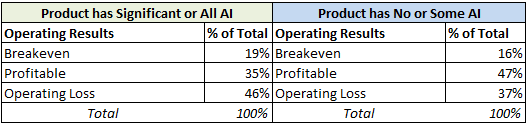
Similar to last year’s survey results, there is no meaningful distinction in profitability between companies with no AI in their product and companies using at least some AI in their product.
However, this changes if we dig one layer deeper and segment the respondents by companies with either significant AI in their product or whose product is entirely AI-based vs. companies using AI as a complement to their core software or not using AI in their product at all.
46% of respondents whose product is significantly or entirely AI-based are operating at a loss compared to 37% of respondents that have limited or no AI in their product.
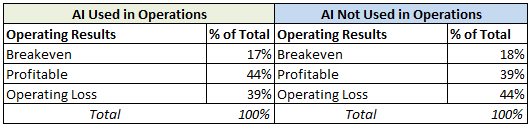
With regard to AI utilization in operations, at the margin, companies appear to be reaping cost efficiencies from AI above whatever incremental spend AI may be driving.
39% of companies using AI in operations reported an operating loss compared to 44% for companies not using AI in operations.
This is consistent with anecdotal evidence from our conversations with SaaS companies and how they are deploying AI in their operations.
AI Utilization and SaaS Spending by Category
The two tables below present median spending as a percent of revenue for operating categories. Companies are segmented based on the size of revenues and whether they are using AI in both their daily operations and product. Looking at companies using AI across both product and operations serves the purpose of mitigating any accounting allocation discrepancies between operations and product among companies. In this way, it can provide a cleaner, holistic picture of how AI is impacting companies’ expenses. Please note that the definition of AI, its purpose (i.e., toward growth or efficiencies), and how it is allocated across expense categories may vary among respondents.
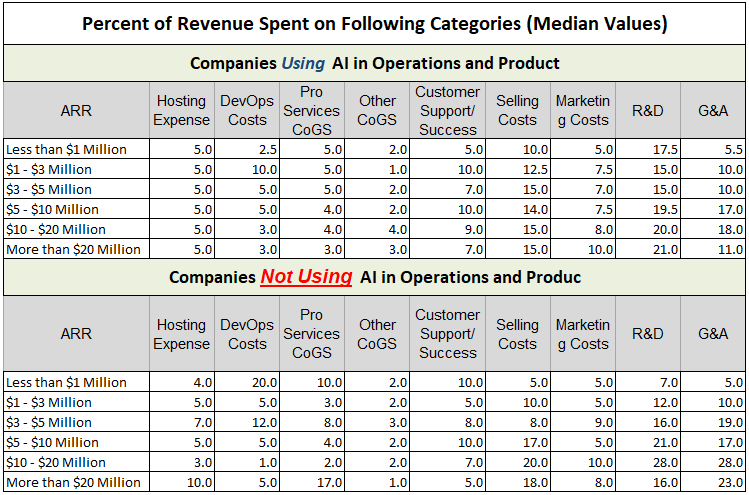
Within the group of companies that are not using AI in either their product or operations, the sample size is particularly small for companies with ARR less than $1 million and with ARR greater than $20 million. Ignoring these categories and lumping all companies with ARR between $1-20 million gives us a broad overview of how AI implementation has affected spending by expense category. Several observations emerge from this, which we can then compare to last year’s survey.
Firstly, companies deploying AI in their operations and product reported slightly lower Customer Support and Customer Success expenses than companies not using AI.
Secondly, companies that adopted AI in product and operations report higher R&D spend compared to companies with no AI in their product or operations. Both an increase in R&D spend for AI users and a decrease in R&D spend for non-AI users relative to last year contributed to this result.
One potential explanation for increasing R&D spend among AI users is that the use case of AI has begun to expand beyond current solutions into new offerings, which is driving up R&D expense.
Lastly, the spend on Sales was the same for companies whether they were using AI or not in their product and operations. This differs from the previous year when companies using AI spent more on Sales compared to their non-AI counterparts; however, this is entirely the result of non-AI companies increasing spend year-over-year rather than any change in relative spend from the companies using AI. Marketing spend remained higher for companies using AI in their product and operations.
Consistent with previous findings, G&A spend was lower for companies using AI. This makes intuitive sense as G&A is a natural area to expect cost efficiencies to manifest from AI utilization.
Conclusion
AI adoption continues to expand across the SaaS industry. Consistent with its myriad applications, the effect of AI on companies’ spend and profitability may vary widely depending on the particular use case, deployment strategy and department impacted.
So far, reduced spending in G&A and increased spending on marketing for companies utilizing AI has been a consistent result over the last two years. Spending for other categories appears to be more variable and dependent on the use case and strategy deployed.
Overall, companies utilizing AI in their operations are more likely to be breakeven or profitable than companies without AI in their operations. The impact on profitability of AI usage in product is less clear.
*In Q1 of each year, SaaS Capital conducts a survey of B2B SaaS company metrics. This year marked our 15th annual survey, and it continues to grow with more than 1,000 private B2B SaaS companies responding, making it the largest survey of its kind.