
7 Best Optimizely Alternatives for A/B Testing and Experimentation

The best Optimizely alternative for website A/B testing is Crazy Egg, which pairs testing with web, conversion, and behavior analytics, followed by Wingify, Kameleoon, and Convert. For product experimentation, Statsig, LaunchDarkly, and GrowthBook are good alternatives to Optimizely Feature Experimentation.
Here’s a detailed breakdown of each tool’s use cases and capabilities, strengths and limitations, and pricing.
Before that, let’s see why you may consider an Optimizely alternative in the first place.
Why Do Teams Switch From Optimizely?
Common reasons why teams switch from Optimizely include:
- No heatmaps or session recordings. To see how visitors behave on a page, you need another tool, such as Contentsquare. So you pay twice.
- Limited analytics. Analyzing test data in depth requires a third-party analytics tool, like GA4. G2 reviewers ask for more customizable dashboards, device or location segments, and easier raw-data export (April 2026).
- Changes beyond the visual editor need a developer. Custom metrics such as scroll depth and single-page app tests require custom JavaScript. Feature Experimentation runs through SDKs in your codebase.
- Advanced tests are hard to preview and debug. Basic tests are easy to set up, but advanced setups come with a learning curve. G2 reviewers say the visual editor’s live preview sometimes “doesn’t show things correctly” (September 2026), and diagnosing a failing test “can take time” (April 2026).
- Common setups require several Optimizely products. Optimizely offers multiple products, and you often need more than one. For example, testing on your site and your app takes Web Experimentation plus Feature Experimentation. And as one enterprise reviewer on G2 said, it’s hard “to figure out what’s included in which package” (November 2026).
- Prices only come through sales. Optimizely doesn’t list prices, so you can’t compare costs until its sales team scopes your needs. Its standard online terms let it raise fees at each 12-month renewal.
- AI costs are hard to forecast. Mark, formerly Opal, runs on credits, and credit use varies with input size. The free 200 credits a month cover about one run of its heaviest agents. As admins can’t cap it per user, organizations, especially large ones, may find it hard to predict and control usage. Some G2 reviewers found Opal “slightly pricey” (September 2026).
Top Optimizely Alternatives at a Glance
Short on time? Here’s how the seven tools compare.
Pricing as of November 2026, from each vendor’s own pricing page.
How I chose these Optimizely alternatives
Here are the criteria I considered when choosing Optimizely alternatives:
- Replaces an Optimizely product: Web Experimentation, Feature Experimentation, or both.
- Testing depth: Test types, stats methods, client-side and server-side tests, and feature flags.
- Behavior insight: Heatmaps and recordings built in, or through an integration.
- AI and data access: In-product AI, MCP servers, and data exports.
- Published pricing: Whether you can see a price before talking to sales.
All information comes from the vendors’ product pages and was verified in November 2026.
The 7 Best Optimizely Alternatives
1. Crazy Egg
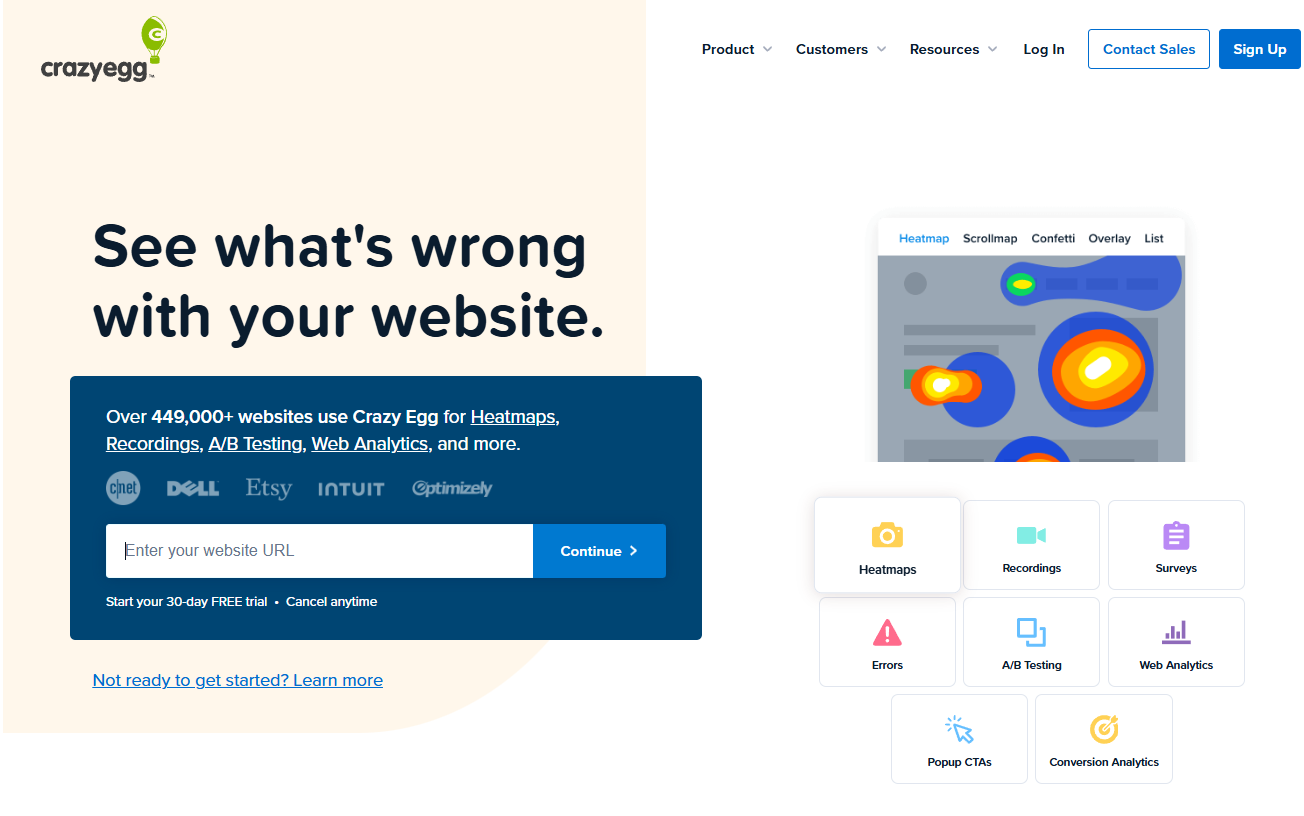
Crazy Egg is an all-in-one behavior analytics and conversion optimization platform trusted by over 449,000 websites, including The North Face, Microsoft, Disney, SAP, Deloitte, and Intuit.
What I like about Crazy Egg:
- Targeted testing and personalization: You can run A/B tests and multi-armed bandit tests (which shift traffic toward the better-performing variation as results come in), targeted by device, country, UTMs, and conversions, or any segment, and personalize the page experiences for different visitor groups (Optimizely sells Personalization as a separate product).
- Full optimization workflow in one tool: You find leaks with web analytics and conversion funnels, diagnose why they leak with heatmaps, session recordings, error tracking, and surveys, A/B test fixes, and analyze each variant’s performance.
- Optimization automation with agentic AI: Tasks recommends tests, designs variants, and can launch experiments.
- AI analysis: AI summaries explain heatmaps, recordings, and traffic trends, and the MCP server lets assistants such as Claude and ChatGPT work with your Crazy Egg data.
- Data security and privacy: Crazy Egg complies with GDPR and CCPA, and offers a Data Processing Agreement (DPA) for companies in regulated industries.
- Responsive support and onboarding: Crazy Egg’s support team covers US working hours and promptly responds to queries, and dedicated customer success managers help larger teams get started.
Crazy Egg limitations:
- No multivariate or multi-page tests: You can’t test combinations of changes, or one change across several pages, in a single experiment.
- US data hosting: Crazy Egg stores data in the US on AWS, which rules it out if your contracts require EU data residence.
Who it’s for: Mid-market and enterprise CRO and marketing teams that want to find out why a page underperforms and test the fix in one tool without complex setup or developer involvement.
Replaces: Optimizely Web Experimentation.
Reviews: G2 4.2 out of 5 (128 reviews).
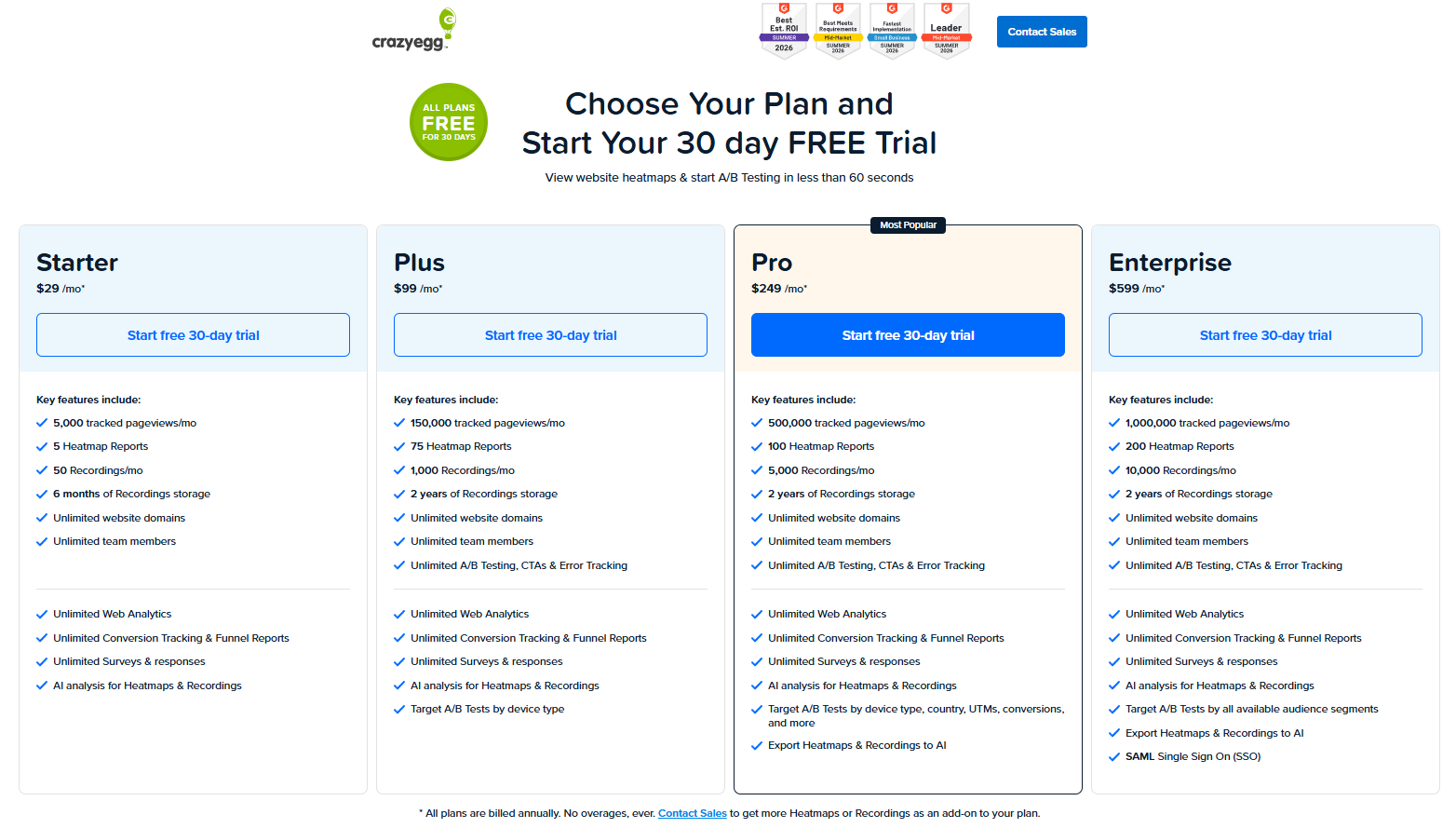
Pricing: Plans with A/B testing start at $99/month, billed annually. Every plan includes unlimited website domains and team members.
2. Wingify (VWO and AB Tasty)
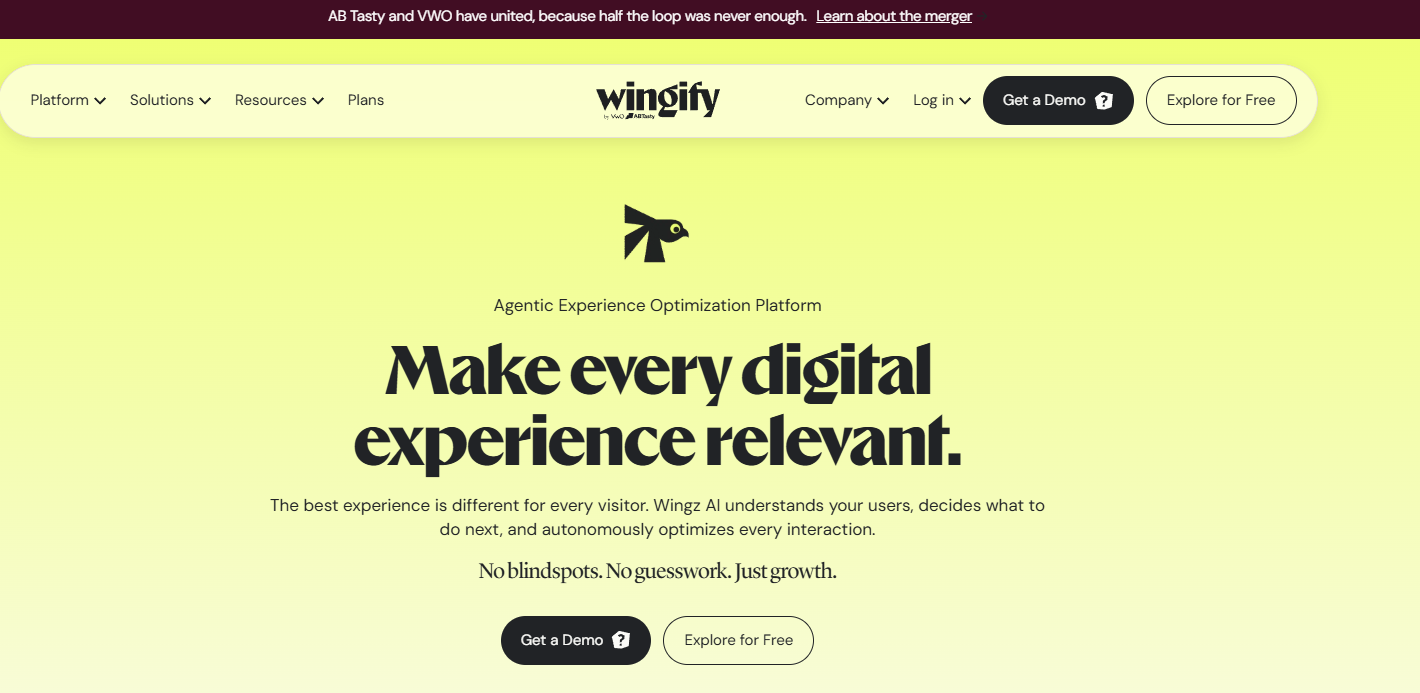
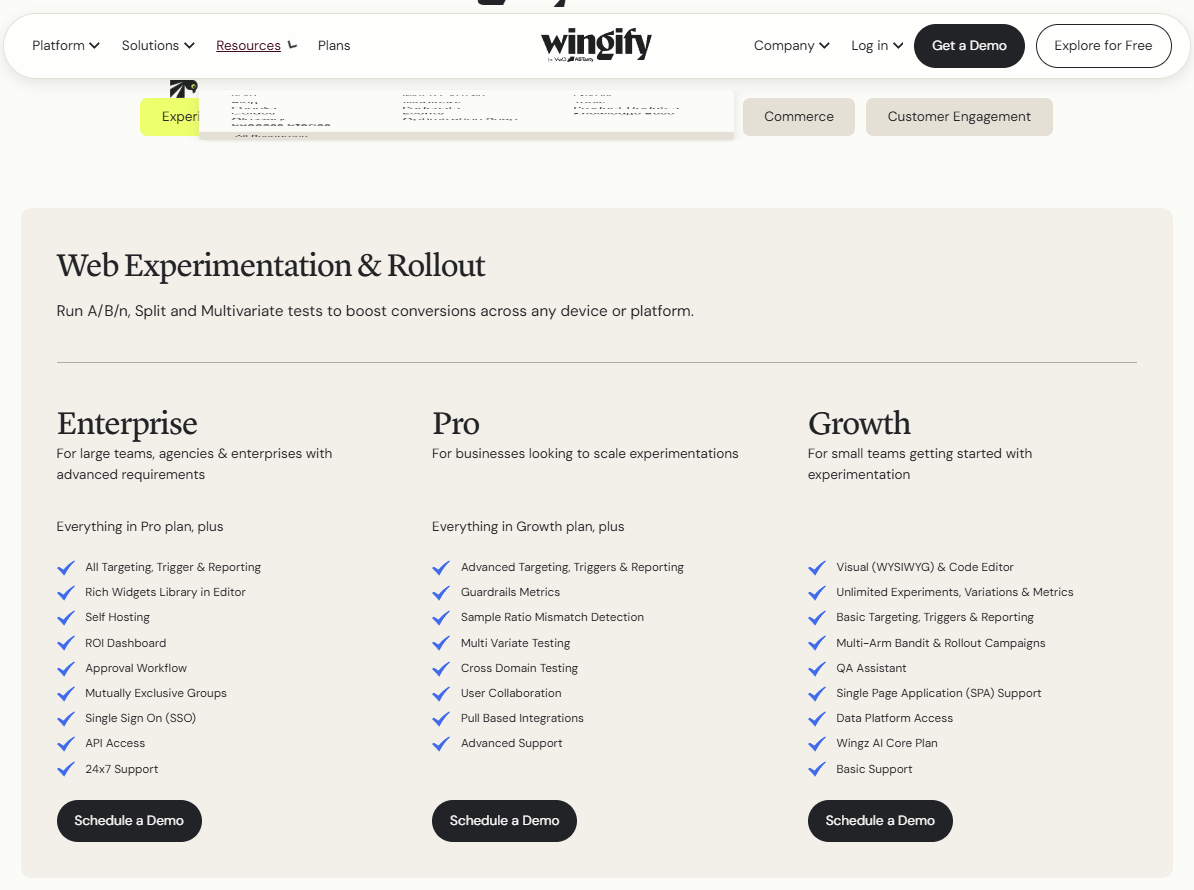
Wingify launched in September 2026 after the VWO and AB Tasty merger. So while the name is new, the product is powered by tried-and-tested experimentation and analytics engines trusted by over 4,000 customers.
What I like about Wingify:
- Web and feature testing: You can run A/B/n, split, and multivariate tests from a visual or code editor, plus feature flags and server-side experiments with open-source SDKs in more than eight languages.
- Behavior analytics: You can see how visitors use pages with heatmaps, session recordings, and form analytics, and ask why with on-page surveys.
- Statistical options: You can choose fixed-horizon or sequential tests, with guardrail metrics that catch harmful tests.
- AI analysis: Wingz AI analyzes campaigns, heatmaps, and recordings, and its MCP server connects your data to ChatGPT and Claude.
Wingify limitations:
- Sold separately: Covering the full optimization loop requires multiple products (experimentation, behavior analytics, and surveys) with custom quotes.
Who it’s for: Marketing and product teams that want experimentation and behavior analytics in one platform.
Replaces: Optimizely Web Experimentation and Feature Experimentation.
Reviews: G2 4.4 out of 5 (1,233 reviews).
Pricing: Custom, based on monthly active users (monthly tracked users for behavior analytics). Vendr’s buyer data puts the median contract at about $16,660 a year for VWO and $66,500 for AB Tasty (pre-merger data).
3. Kameleoon
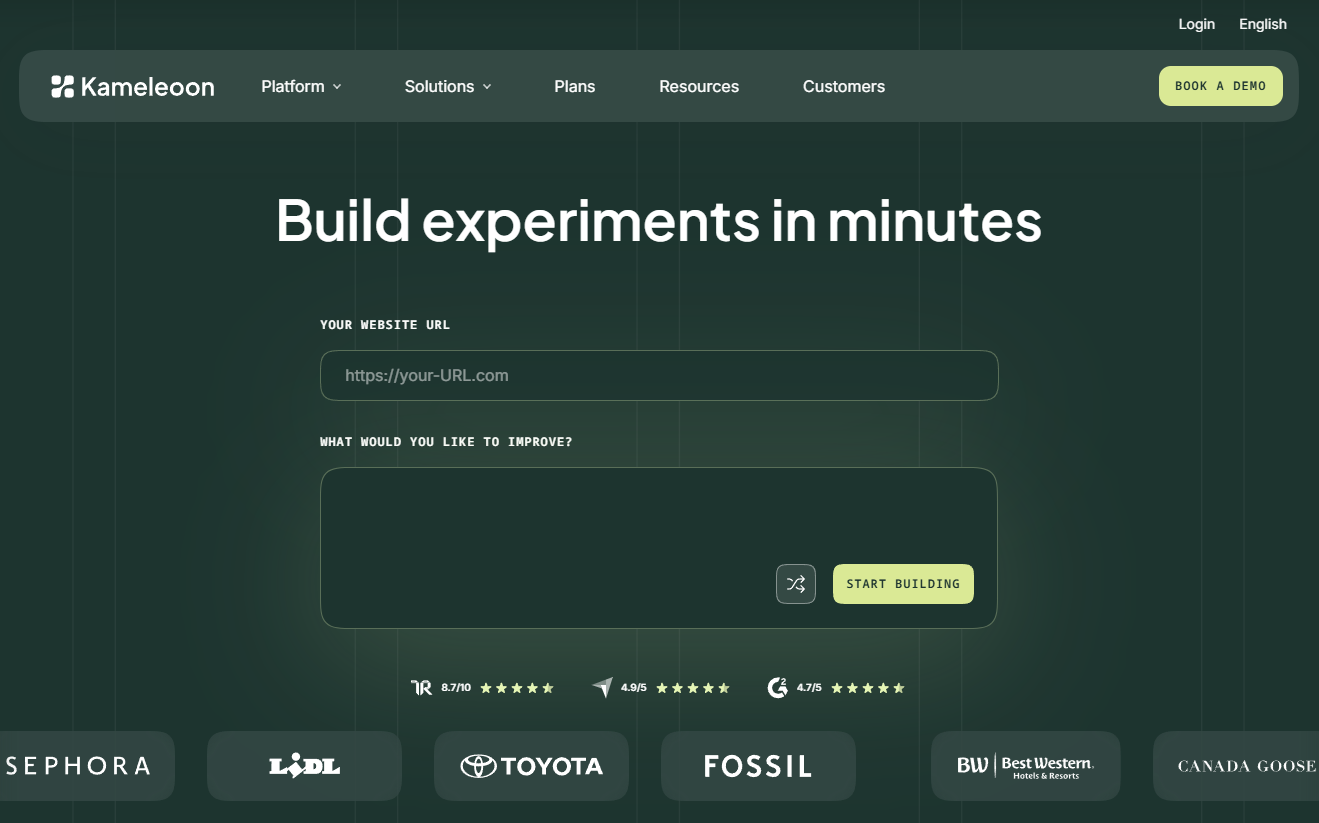
Kameleoon is a web and feature experimentation platform known for AI-assisted testing, trusted by over 1,000 brands, including Samsung, Lidl, and Fnac Darty.
What I like about Kameleoon:
- Tests built from a prompt: You can describe a change in plain language, and AI generates the variation and launches the experiment without code or a visual editor.
- AI agents across the test cycle: The Ideate agent suggests what to test, Configure sets up audiences and goals in a chat, and Ship moves winning tests into production through an MCP server.
- Statistical safeguards: It lets you run sequential tests and holdout groups, with multiple-testing correction and alerts for uneven traffic splits.
- Web and feature experimentation: You can manage feature flags and rollouts, run feature experiments, and test mobile apps.
Kameleoon limitations:
- No heatmaps or session recordings: Kameleoon connects to tools such as Crazy Egg or Hotjar, and that’s the only way to see how visitors behave on each variation.
- AI work runs on credits: Each prompt-built experiment uses one or two credits; unused credits don’t roll over, and Starter experiments stop when you reach your monthly limit.
Who it’s for: Product and marketing teams that want AI to build and launch tests with little or no code.
Replaces: Optimizely Web Experimentation (and Feature Experimentation on Enterprise).
Reviews: G2 4.5 out of 5 (140 reviews).
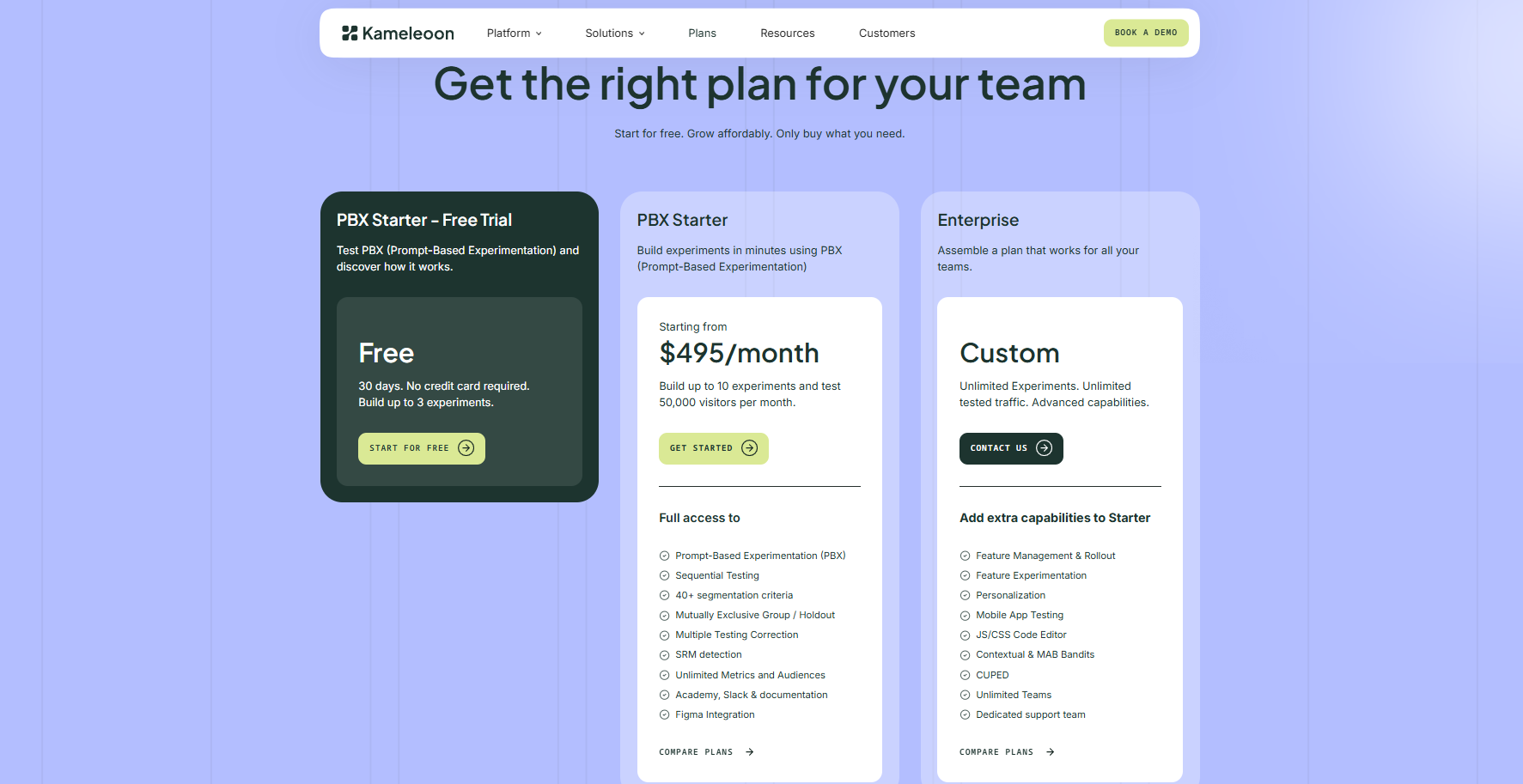
Pricing: The Prompt-Based Experimentation (PBX) Starter plan costs from $495/month, billed monthly. Feature experimentation, personalization, and mobile testing need a custom Enterprise plan.
4. Convert
Convert Experiences is a bootstrapped testing and personalization platform that has been around for 17 years, used by CRO agencies such as Conversion Rate Experts and Cro Metrics.
What I like about Convert:
- Web and feature experimentation: You can build tests in a visual or code editor and run feature tests, flags, and rollouts through SDKs for JavaScript, PHP, Ruby, Python, Android, and iOS.
- Testing depth: Convert enables A/B, split URL, multivariate, multipage, and multi-armed bandit tests. You can analyze them with frequentist, Bayesian, or sequential statistics.
- Behavior data in experiment reports: You get heatmaps and friction-filtered session recordings for the control and every variation inside the experiment report.
- AI and data access: Your AI assistants work with your Convert account through an MCP server. The Convert Intelligence assistant helps set up variations, analyze results, and suggest hypotheses.
- EU data residence & privacy: Convert stores your data on servers in Frankfurt and uses only first-party cookies. It holds SOC 2 attestation and ISO 27001 certification.
Convert limitations:
- AI assistant still in beta: Convert Intelligence isn’t a fully developed feature yet.
- No surveys: Collecting user feedback requires a separate survey tool.
Who it’s for: Marketing and CRO teams and agencies that need EU data hosting and advanced testing capabilities.
Replaces: Optimizely Web Experimentation (and Feature Experimentation on Pro).
Reviews: G2 4.6 out of 5 (100 reviews).
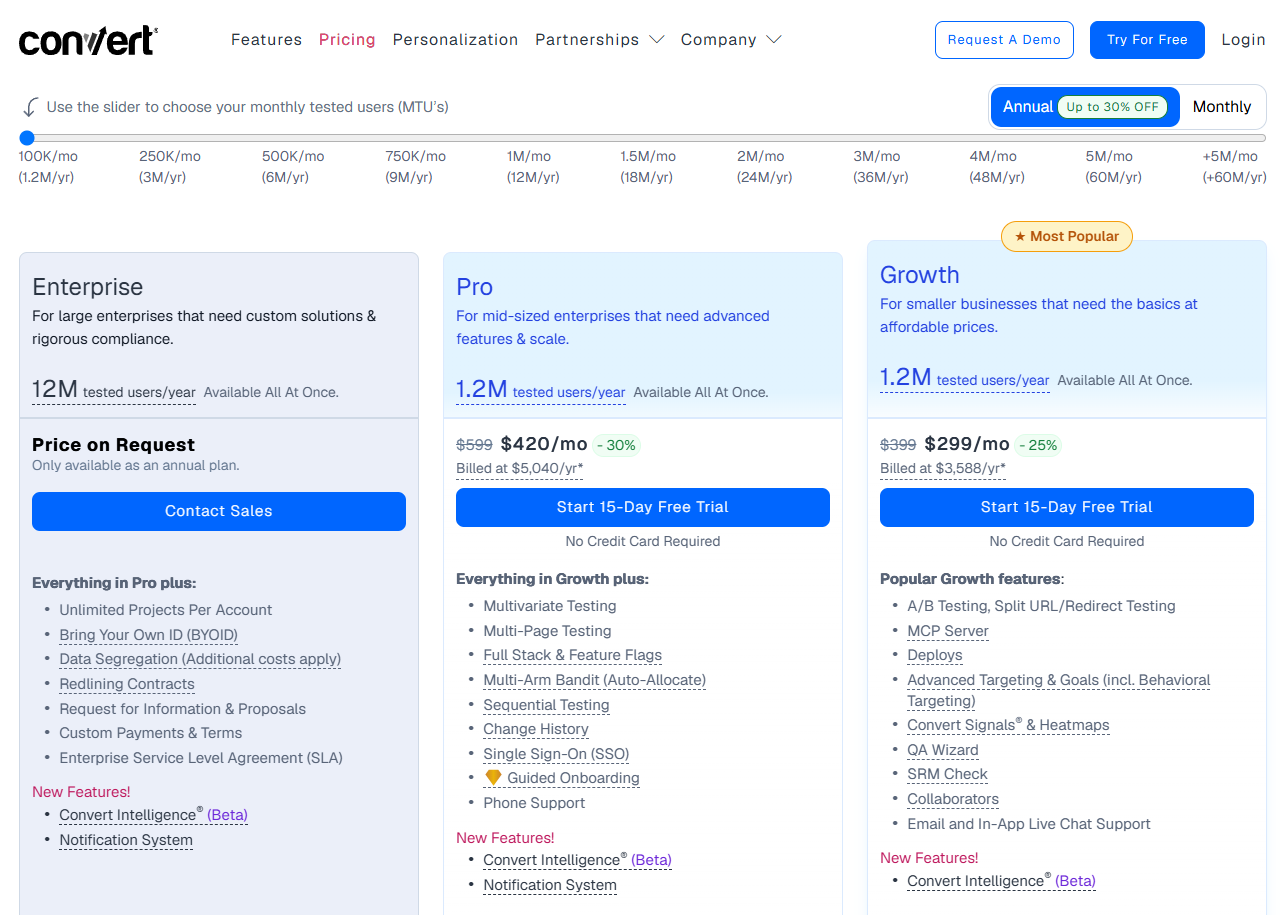
Pricing: The Growth plan costs $299/month billed annually or $399/month billed monthly. Multivariate, multipage, and full-stack testing start on the Pro plan at $420/month billed annually or $599/month billed monthly.
5. Statsig
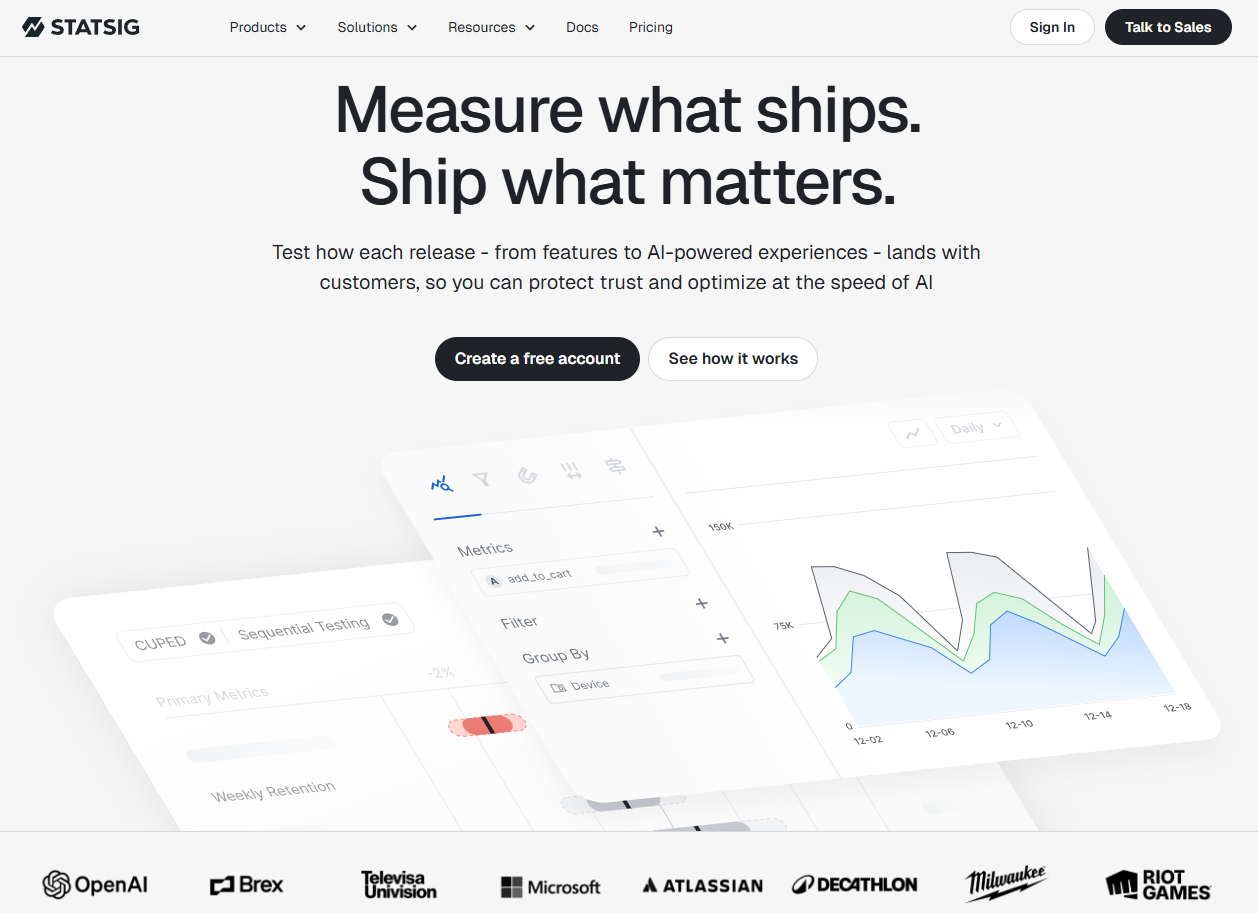
Statsig is an experimentation and feature flag platform that processes over 1 trillion events a day for companies such as OpenAI, Microsoft, Atlassian, and Brex.
What I like about Statsig:
- Feature flags and experiments: Feature flags let you switch features on and off and roll them out to chosen users, and you can run A/B/n, multivariate, and multi-armed bandit experiments through more than 30 SDKs, including contextual bandits that personalize the variant each user sees.
- Statistics engine: Statsig supports Bayesian and frequentist analysis, CUPED variance reduction, sequential testing, switchback and non-inferiority tests, and multiple-comparison corrections.
- Analytics on the same data: Product analytics, web analytics, and session replay sit alongside your experiments, and you can filter web and mobile replays to users in a specific treatment group.
- AI experimentation and access: Agent Experimentation lets you test changes to your AI features and their impact on metrics such as retention. An MCP server connects AI assistants to your Statsig data.
Statsig limitations:
- No heatmaps: Statsig records click and scroll events and session replays, but has no heatmap view.
- Visual editor in maintenance mode: Statsig’s no-code editor gets no new features or bug fixes, and its docs point visual web testing to Amplitude Web Experiment (Amplitude took over Statsig’s brand and customers in May 2026).
Who it’s for: Product and engineering teams that want experiments, feature flags, and product analytics in one place.
Replaces: Optimizely Feature Experimentation.
Reviews: G2 4.7 out of 5 (349 reviews).
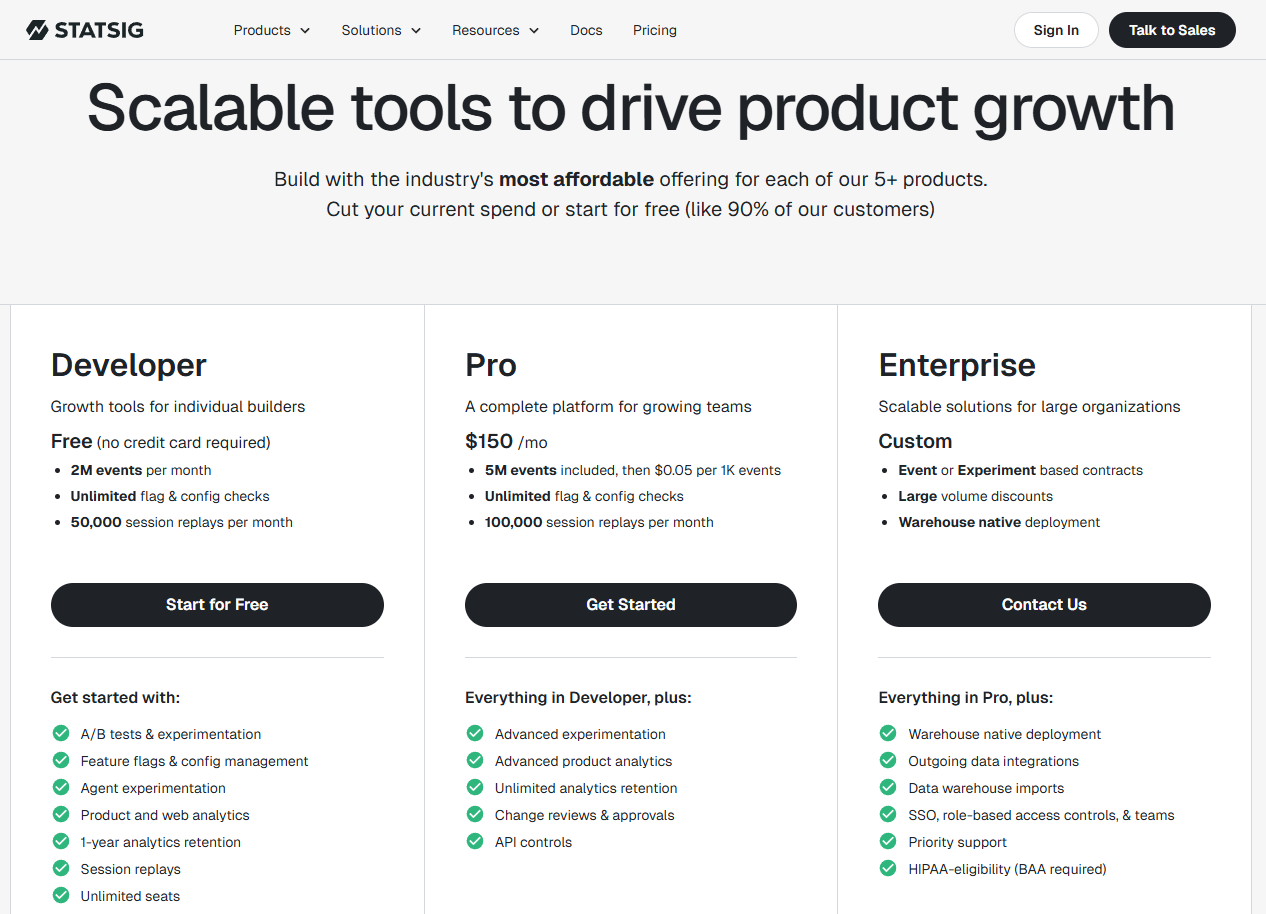
Pricing: The free Developer plan includes 2 million events and 50,000 session replays a month. Pro costs $150/month with 5 million events included, then $0.05 per 1,000 events. Enterprise pricing is custom.
6. LaunchDarkly
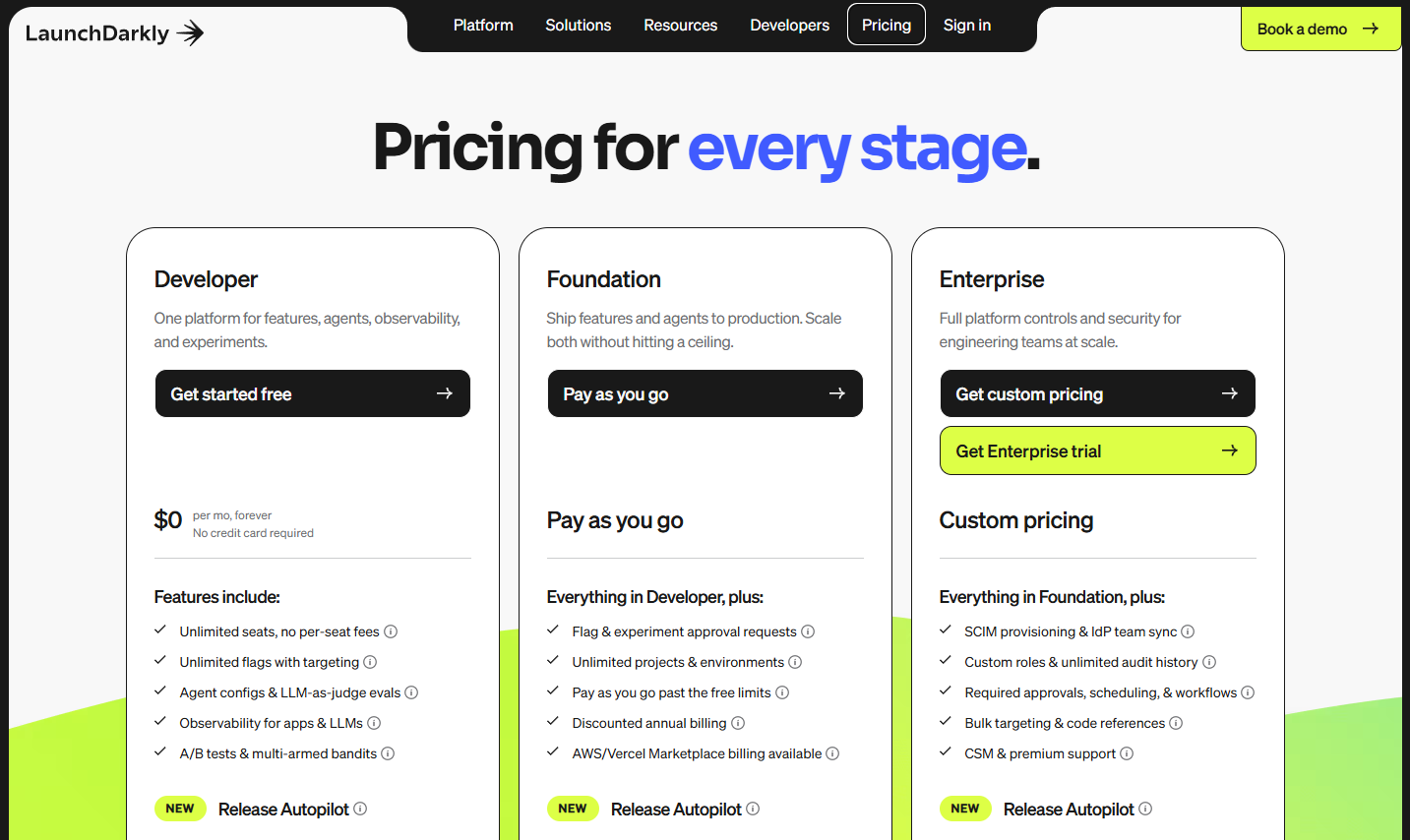
LaunchDarkly is a feature management and experimentation platform used by companies such as Hulu, Dior, Veeam, and Savage X Fenty.
What I like about LaunchDarkly:
- Release control: You can roll changes out progressively and roll them back automatically when metrics drop. Release Autopilot automates flagging, rollouts, rollbacks, and flag cleanup.
- Experimentation on your flags: It supports A/B/n tests, multi-armed bandits, and holdouts on feature flags. The testing engine runs on Bayesian or frequentist statistics and includes CUPED, sequential testing, and sample ratio mismatch detection.
- Warehouse-native option: Experiments can pull data from Snowflake, Redshift, Databricks, BigQuery, and more.
- User behavior analytics: Session replays and heatmaps show what users clicked, saw, and did around a release, alongside errors, logs, and traces.
- AI control: AgentControl lets you test your AI feature prompts and models in production, and the MCP server lets an AI agent run an end-to-end experiment in a chat.
LaunchDarkly limitations:
- No visual editor: As a developer-focused release platform, LaunchDarkly runs experiments on feature flags in code.
- Usage-based pricing: Costs depend on service connections, client-side monthly active users, and session replays, so forecasting a bill means estimating all three.
Who it’s for: Engineering and product teams that test features as they release them.
Replaces: Optimizely Feature Experimentation.
Reviews: G2 4.5 out of 5 (927 reviews).
Pricing: The free Developer plan includes unlimited seats, 5 service connections, 1,000 client-side monthly active users, and 5,000 session replays. The pay-as-you-go Foundation plan then charges $10 per service connection and $8.33 per 1,000 client-side monthly active users, billed annually. Enterprise pricing is custom.
7. GrowthBook
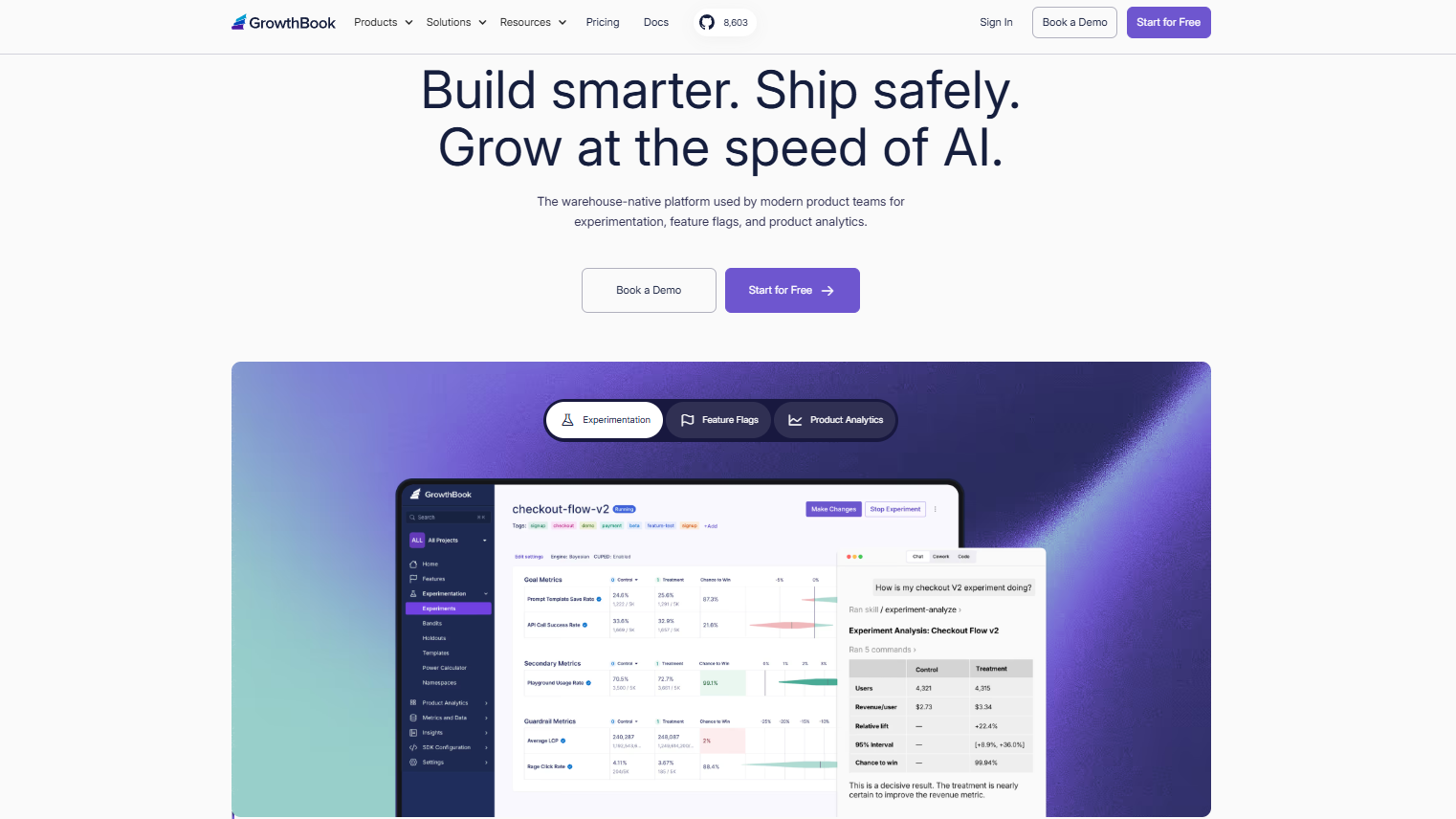
GrowthBook is an open-source experimentation and feature flag platform trusted by over 4,000 companies, including Dropbox, Sony, Khan Academy, and Wikipedia.
What I like about GrowthBook:
- Warehouse-native analysis: GrowthBook calculates experiment results directly from your data warehouse (e.g., Snowflake, BigQuery, Redshift, Databricks, and ClickHouse).
- Self-hosted or cloud: You can run the product on GrowthBook’s cloud or on your own servers.
- Code and no-code tests: Engineers run feature flag experiments through more than 24 SDKs, and marketers build web tests in the AI Visual Editor, which generates variations from a prompt or a point-and-click editor.
- Statistics engine: You can choose Bayesian or frequentist analysis, with CUPED, sequential testing, multi-armed bandits, multiple-testing corrections, and sample ratio mismatch detection.
- AI analysis and access: An AI Analyst answers questions about your product data, and the MCP server lets AI assistants work with GrowthBook.
GrowthBook limitations:
- No heatmaps or session recordings: GrowthBook points to a Microsoft Clarity integration for heatmaps and recordings of experiment pages.
Who it’s for: Product and data teams that want experiment analysis in their own warehouse, with the option to self-host.
Replaces: Optimizely Feature Experimentation (and Web Experimentation on Pro and Enterprise).
Reviews: G2 4.6 out of 5 (26 reviews).
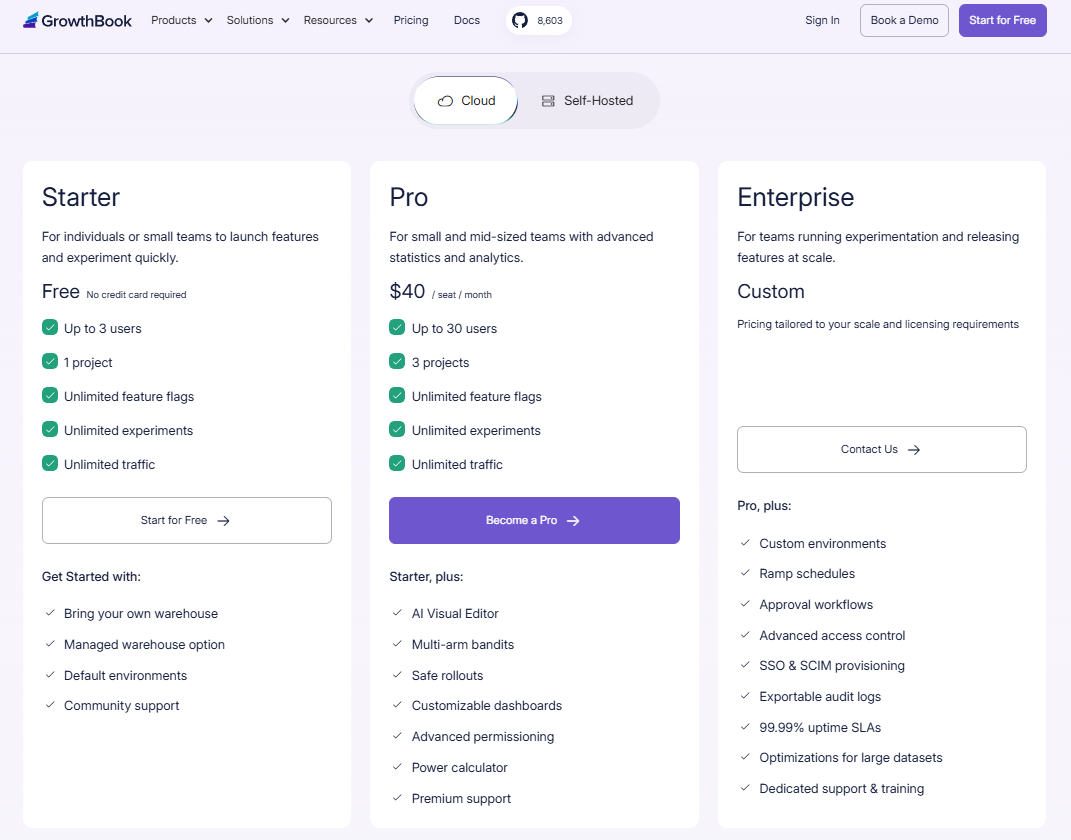
Pricing: The self-hosted open-source plan is free with unlimited users. In the cloud, Starter is free for up to 3 users, and Pro costs $40/seat/month for up to 30 users.
Tools That Won’t Replace Optimizely Experimentation
Other tool roundups on Google include products that aren’t really Optimizely competitors because they serve different use cases or have limited capabilities.
Here are products that aren’t Optimizely alternatives:
- Unbounce: It’s a landing page builder, not an experimentation tool, and its A/B tests run on the landing pages, pop-ups, and sticky bars you build in Unbounce.
- Google Optimize: Google Optimize is no longer available after the company sunsetted it on September 30, 2023.
- CMS platforms: WordPress, Drupal, Webflow, and others replace Optimizely’s content management system, not its experimentation products.
Verdict: Which Optimizely Alternative Should You Choose?
The right Optimizely alternative depends on which Optimizely product you’re replacing and which team will run the tests. Marketing and CRO teams replacing Web Experimentation should compare Crazy Egg, Wingify, Kameleoon, and Convert, while product and engineering teams replacing Feature Experimentation should look at Statsig, LaunchDarkly, and GrowthBook.
Within each group, choose by the gap you need to fill: behavior analytics, AI-built tests, EU data hosting, product analytics, release control, or warehouse-native analysis.
If you want to learn why your website visitors behave the way they do and test the fix in the same tool, Crazy Egg covers the whole process. Contact Crazy Egg’s sales team to learn how it can help you optimize your website and, if you’re leaving Optimizely, how to make a smooth transition.
Frequently Asked Questions About Optimizely and Its Alternatives
How much does Optimizely cost?
Optimizely’s experimentation products cost around $50,000 to $80,000 a year for mid-market deployments and rise past $200,000 for enterprise deployments, according to Vendr’s buyer data, with annual price escalators of 3% to 7% (February 2026). Optimizely doesn’t publish its prices, so every plan starts with a personalized quote from its sales team.
What is the cheapest Optimizely alternative?
The cheapest Optimizely alternatives are free plans: LaunchDarkly’s Developer plan and GrowthBook’s Starter and self-hosted plans include experimentation at no cost, and both suit teams that test in product code. For web testing with a visual editor, Crazy Egg has the lowest published price on this list, with A/B testing from $99/month billed annually.
Is there a free or open-source Optimizely alternative?
Yes, GrowthBook is one free, open-source Optimizely alternative that you can self-host with unlimited users, and it covers feature flags, experiments, and warehouse-native analysis. PostHog is also open source and combines experiments with session replay and heatmaps, but it labels its no-code web experiments as beta.
How do you switch from Optimizely without losing experiment data?
To switch from Optimizely without losing experiment data, download experiment results as CSV files from the app or REST API, and raw event data through Experimentation Events Export before your subscription ends. Then, recreate your audiences and goals in the new tool.
Is Optimizely the same as Episerver?
Yes, Optimizely is the former Episerver. Episerver, a digital experience platform company, bought the original Optimizely testing company in 2020. It rebranded itself as Optimizely in January 2021, which is why Optimizely sells a content management system alongside its experimentation products.

