
Greenwashing in Web Hosting | GreenGeeks
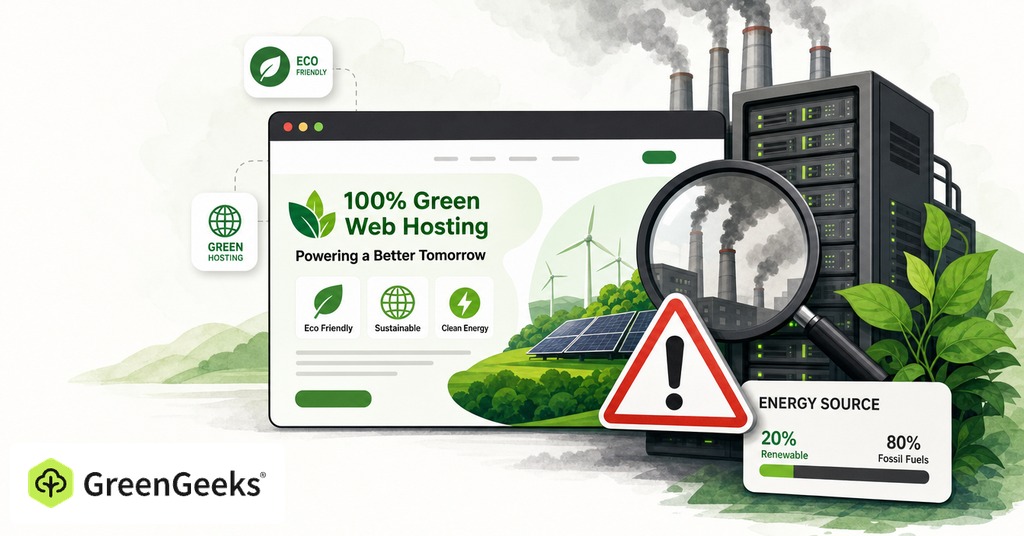

A hosting company that spent years listing itself as an EPA Green Power Partner left the program and let the claim stay on its site. Asked about it by a customer, its own support account answered in public that most of the programs a company can sign up for are close to a sham with nothing behind them to verify. A defensible host differs from a greenwashed one in that a buyer can check its claim. In the shared-hosting tier almost every claim rests on renewable energy certificates bought after the fact.
What Greenwashing in Web Hosting Looks Like
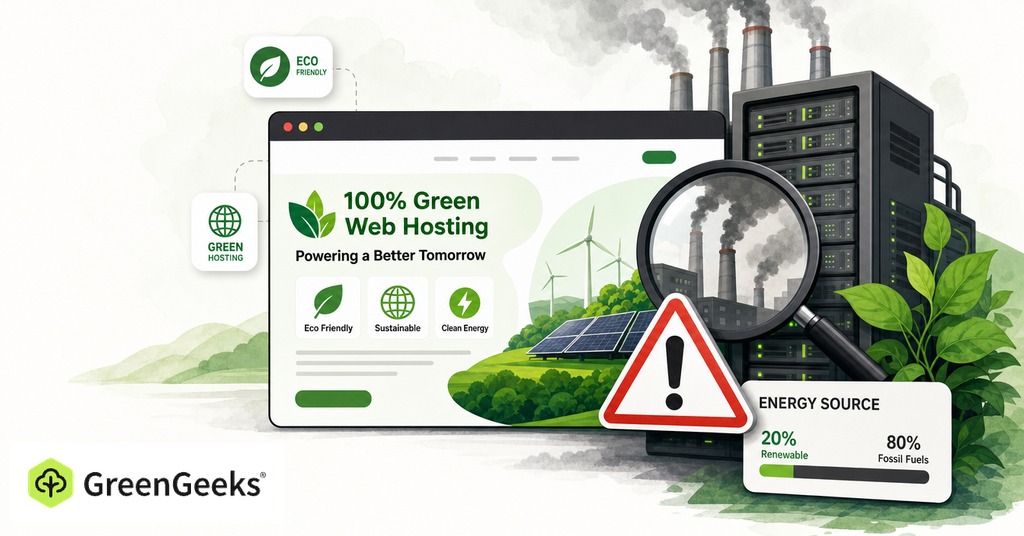
Six patterns cover most of what appears on hosting sustainability pages, and a buyer cannot look up any of them.
A carbon neutral claim will either name an offset registry, a project, a retirement serial and a vintage year, or it will name none of them.

A renewable claim is either traceable to a named mechanism or worded to avoid one.
A renewable claim with no year attached cannot be checked at all. Certificates are annual instruments, and a claim outside a reporting period has no referent.
The phrase eco-friendly servers describes hardware in a way that measures nothing.
A leaf badge designed in-house has no issuing body and no standard document behind it, unlike the eco-friendly labels that carry a published standard.
A tree counter without a named partner or a planting location cannot be traced to a site.
The undated statistic appears even on pages that are otherwise careful. Share-of-emissions statistics circulate through hosting marketing with no source and no date, and most trace to a single mid-2010s worst-case projection since criticized as an overestimate. A page that opens on an alarming number without saying where it came from has not established the number.
Some of the wording is copied. A marketing page written by someone who read three other marketing pages produces exactly this. The effect on a buyer is the same either way. A buyer can settle the question by identifying what specifically is being claimed and where that claim can be looked up.
What a Renewable Energy Certificate Is
Bundled and Unbundled Renewable Energy Certificates
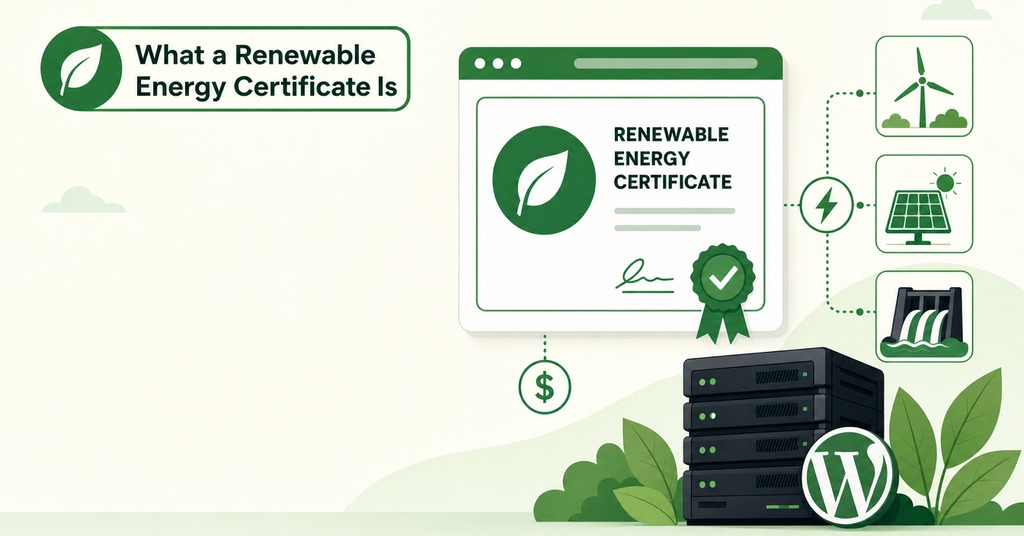
A renewable energy certificate represents the environmental attributes of one megawatt-hour of renewable electricity delivered to a grid. The certificate and the electricity can be sold together or separately. Sold together, in a green tariff or a physical power purchase agreement or on-site generation, the certificate is bundled and the buyer receives the power. Sold on its own, the certificate is unbundled. The buyer has bought the legal right to claim the attribute from a generator that may be in another state or another grid region entirely, and this unbundled form is the exact instrument the serious criticism is aimed at.
The Difference Between a REC and a Carbon Offset
A certificate represents a megawatt-hour of generation. An electricity registry such as WREGIS or PJM GATS tracks it. A carbon offset represents a metric ton of carbon dioxide equivalent reduced or removed, usually by a project in a different sector such as forestry or methane capture, and is tracked by Verra or Gold Standard. The two instruments differ in unit, registry and verification body, and they fail in different ways.
A host that writes about purchasing wind energy credits to offset its carbon footprint has put both categories in one sentence, and that wording appears constantly, including in careful reviews.
Why Renewable Energy Certificates Are Contested
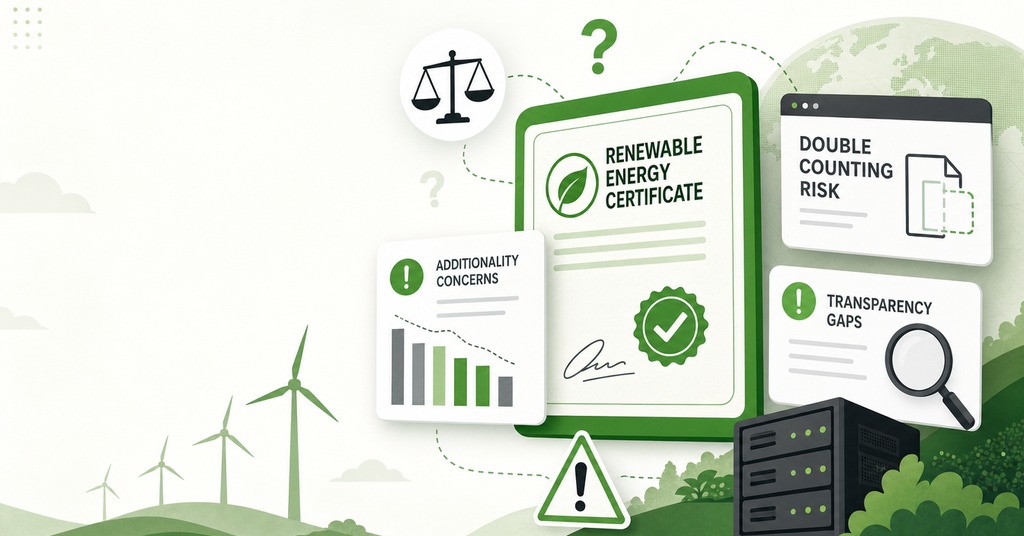
A 2022 study of companies with science-based targets found that removing the reductions claimed through certificates left their combined 2015 to 2019 scope 2 trajectories out of alignment with the 1.5 degree goal and barely aligned with the well below 2 degree goal. On current trends, 42% of committed scope 2 emission reductions will not produce real-world mitigation.
Tightening the rules on which certificates count removes much of the reported progress. A 2025 recalculation took 206 companies out of the CDP disclosure dataset and reworked their market-based scope 2 emissions after invalidating certificates that would fail three proposed restrictions, requiring generation in the same country as consumption, a generator commissioned within 36 months, and sourcing through a power purchase agreement. The sample had more than doubled its certificate purchases between 2019 and 2022. Under all three restrictions the combined reported reduction fell from 21% to 17%, and the share of companies behind on their climate target rose from 28% to 50%.
The economic mechanism behind those findings is simpler than the accounting. Voluntary national certificates have traded well under a dollar per megawatt-hour, in cited ranges from about 31 cents to 70 cents, at a time when the levelized cost of new renewable generation was 50 to 60 dollars per megawatt-hour. A revenue stream worth around 1% of a project’s economics cannot plausibly be the input that causes a wind farm to be built. Unbundled purchases are also short-dated, and a developer seeking financing needs a long, bankable commitment that a one-year certificate purchase does not provide.
Additionality asks whether the purchase caused any generation that would not otherwise exist, and deliverability asks whether the generation could physically reach the consuming facility at all. A certificate bought in Texas for a server in Amsterdam plainly cannot.
Renewable Energy Certificates That Hold Up
Certificate registries are the reason two parties cannot claim the same megawatt-hour and the reason a bundled power purchase agreement or a green tariff can be audited at all, and without them a green claim could not be checked against any record. In compliance markets, where state renewable portfolio standards create demand, certificate prices reach tens of dollars per megawatt-hour and do move project economics, so the additionality argument is aimed specifically at voluntary, unbundled, national certificates.
Defenders of the market answer the price argument by pointing at market design. An illiquid and opaque market produces a weak price signal. That explains the low price without changing what a buyer gets for it today.
Market-Based & Location-Based Scope 2 Emissions
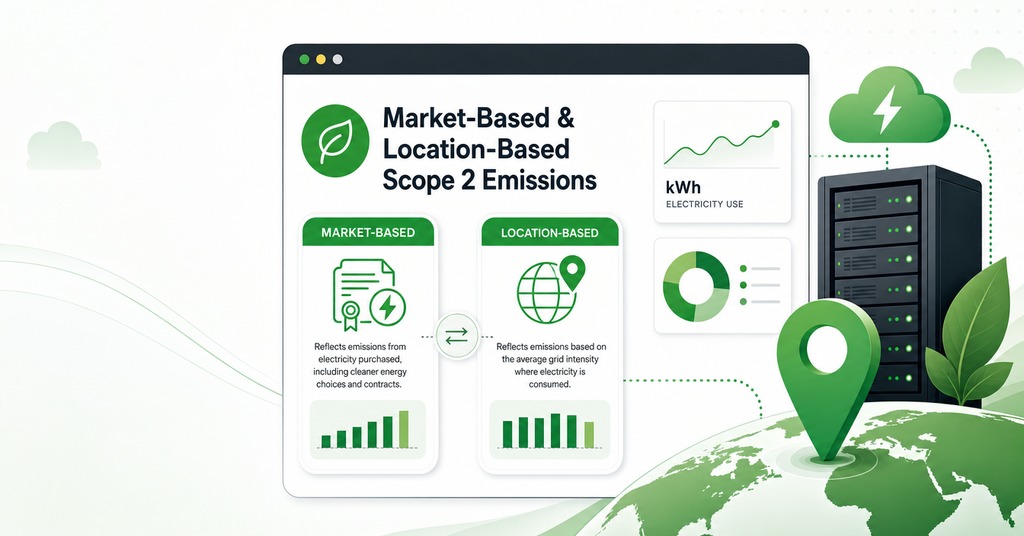
Every company reporting purchased-electricity emissions under the GHG Protocol produces two figures. The location-based figure uses the average emissions intensity of the grid each facility physically connects to. The market-based figure uses contractual instruments, meaning certificates, power purchase agreements, green tariffs and supplier-specific factors. The same building, in the same year, can report thousands of metric tons one way and zero the other.
Nearly every green hosting claim is the market-based figure. The location-based number for the same data centers is almost never published, and the difference between the two figures is the size of the accounting claim.
The GHG Protocol has begun tightening the method, opening a public consultation on revisions to its Scope 2 Guidance on 20 October 2025 and extending it to 31 January 2026, with a new standard expected in 2027. The central proposal is an hourly matching and deliverability requirement for market-based reporting, intended to align emissions claims with the time and place electricity is consumed. Since GHG Protocol standards are referenced by IFRS S2, the EU’s reporting rules and California SB 253, a change here propagates into national and regional law. The proposal would stop unbundled certificates bought in annual volumes from satisfying market-based reporting and push buyers toward corporate power purchase agreements.
The proposal does not cut off existing practice at once. It includes load profiles to approximate hourly data, exemption thresholds, a legacy clause for existing contracts and a phased timeline, and a small host would probably fall under the exemptions. A buyer choosing today is choosing against a standard that is moving toward hourly matching.
Google’s 100% & 66% Renewable Energy Numbers
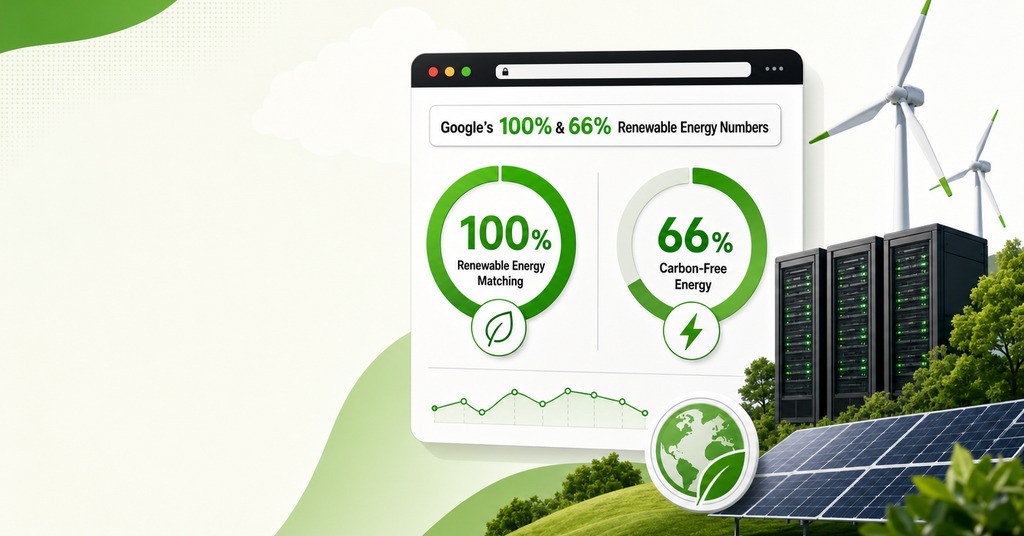
Google has maintained a 100% annual renewable energy match on a global basis every year since 2017. Measured on an hourly basis, its global average carbon-free energy score across data centers and offices was 66% in 2024, up from 64% the year before. Two answers about the same year of the same company’s electricity are 34 points apart.
The regional detail is more instructive than the headline. Nine of 20 grid regions with Google-owned data centers reached at least 80%. Latin America averaged around 92% and North America around 70%. Asia-Pacific came in at 12%. Grid carbon intensity in a region limits the result regardless of how many certificates a host buys. A host with servers in Quebec or Norway starts from a low-carbon position before it buys anything, and a host in a coal-heavy region is buying its way to a number no matter how large the purchase.
Google publishes the methodology, so a reader can check the arithmetic, and the Asia-Pacific figure of 12% is published alongside the global average.
How to Check a Web Host’s Green Claim
The Five Mechanisms a Green Claim Can Rest On
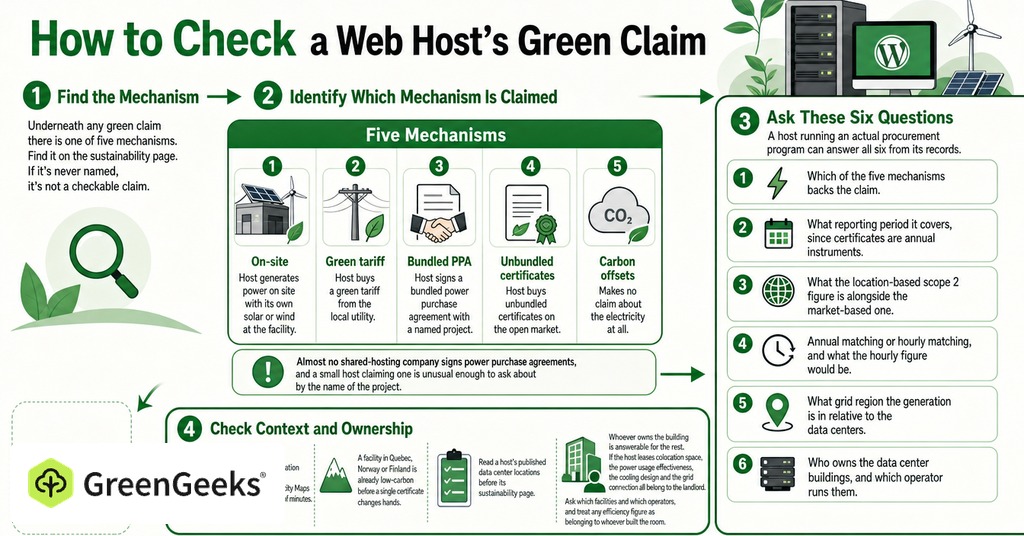
Underneath any green claim there is one of five mechanisms. The host may generate power on site with its own solar or wind at the facility. It may buy a green tariff from the local utility, sign a bundled power purchase agreement with a named project, or buy unbundled certificates on the open market. The fifth is carbon offsets, which make no claim about the electricity at all.
Find the sustainability page and work out which one is being claimed, since a page that never names the mechanism is not making a checkable claim. Almost no shared-hosting company signs power purchase agreements, and a small host claiming one is unusual enough to ask about by the name of the project.
Questions to Ask a Host Before You Buy
A host running an actual procurement program can answer all six of these questions from its own records.
Which of the five mechanisms backs the claim.
What reporting period it covers, since certificates are annual instruments.
What the location-based scope 2 figure is alongside the market-based one.
Annual matching or hourly matching, and what the hourly figure would be.
What grid region the generation is in relative to the data centers.
Who owns the data center buildings, and which operator runs them.
Where the Servers Physically Are
Grid intensity by location is public data, available from Electricity Maps or Ember in a couple of minutes. A facility in Quebec, Norway or Finland is already low-carbon before a single certificate changes hands. Read a host’s published data center locations before its sustainability page.
Whoever owns the building is answerable for the rest. If the host leases colocation space, the power usage effectiveness, the cooling design and the grid connection all belong to the landlord. Ask which facilities and which operators, and treat any efficiency figure as belonging to whoever built the room.
What PUE Measures and What It Does Not
Power usage effectiveness is the ratio of total facility power to power reaching the servers. The metric is misread consistently. A figure of 1.5 means half a watt of overhead for every watt of computing. It measures waste and says nothing about where the electricity came from, so a coal-powered facility at 1.1 is more efficient and dirtier than a hydro-powered one at 1.5. The metric was designed to track a single facility from year to year, and a host leading with one figure is inviting a comparison the number cannot support.
Green Hosting Certifications & What They Verify
Three credentials account for most of the badges on hosting sustainability pages, and each verifies something narrower than the badge suggests.
EPA Green Power Partnership
EPA has run this program since 2001. Membership is open to organizations using at least 100,000 kWh a year. Green power must come from US projects placed in service in the last 15 years and delivered to US operations, and it has to be voluntary purchasing above any state renewable portfolio standard. Partners file an annual reporting form, and EPA suspends partners who fail to file or who make inappropriate claims. Providers of green power are barred from joining as partners.
EPA does not audit anybody’s electricity meters. It verifies eligibility rules and publishes what partners report, and that record is checkable. The partner lists are rendered from public files, and searching a company name returns the annual kWh figure, the percentage of total electricity, the provider and the resource type. A degree symbol beside the provider name indicates a third-party certified product. Its absence means the purchase has no independent certification.
EPA finalized program updates in January 2025 that add optional new metrics for location matching, time matching and emissions balance matching. Those metrics are optional and one step behind the GHG Protocol revision, though they move in the same direction.
Green-e Energy Certification
Green-e, run by the Center for Resource Solutions, is the leading third-party certification for voluntary renewable electricity in North America, and the one with independent verification behind it. Certified power must come from approved sources built in the last 15 years, must be registered in an approved tracking system such as WREGIS or PJM GATS, and it cannot be double-counted toward a state mandate. Its governance board includes the Union of Concerned Scientists, NRDC and CDP. A certificate outside a tracking registry cannot be verified against double-counting at all. A registry entry is a row with a serial number, a generation month, a facility name and a retirement status.
The Green Web Foundation Badge & ISO 14001
The Green Web Foundation badge is the one most likely to appear on a hosting page and is weaker than it looks. Providers qualify by demonstrating they avoid, reduce or offset the emissions from their electricity, and all three tiers earn the same badge. A provider on a 99% renewable grid and a provider buying carbon offsets appear identically in the directory. Evidence must cover the last full calendar year and be renewed annually, and providers can mark it private, in which case nobody can see it in the directory, the checker or the API. The permissiveness matters because around seven million checks a day are made against that dataset.
ISO 14001 is a management-system standard, certifying that an organization has a documented process for managing environmental impact and improving it. The standard says nothing about an emissions figure or an energy source. It certifies a process rather than an outcome.
Green Hosting Claims You Can Check
Hetzner owns and designs its own data centers, states that its German facilities have used hydropower since 2008 and its Finnish park since it opened in 2018, publishes a power usage effectiveness range of 1.10 to 1.16, and uses outside-air cooling for up to 98% of the year. It routes waste heat into its own offices, extends server life to an average of eight years through an internal auction and repair pipeline, and publishes per-server power consumption in watts in its product matrix.
Per-facility efficiency figures are harder to publish than one company-wide number, and Krystal names each data center and its figure individually. It states that it aims to power operations directly with clean energy rather than relying on offsets. The tree-planting program on the same page is unverified by any third party.
Checkable and unverifiable claims appear on the same Infomaniak page. Its reported average efficiency below 1.1, outside-air cooling since 2013, heat recovery into district heating, certified renewable electricity and 15-year server service life can all be checked. The carbon neutral claim built on offsetting 200% of emissions is the claim type the EU’s Empowering Consumers Directive prohibits at product level from 27 September 2026.
OVHcloud publishes a per-site environmental impact tracker that lets a buyer look up the facility their servers are in, and Google Cloud publishes hourly carbon-free energy scores by grid region. Both disclosures let a reader check a single named facility. Against a page that says eco-friendly servers powered by renewable energy, the difference is that one set of statements can be proved wrong and the other cannot be tested at all.
Does GreenGeeks Pass Its Own Test?
The same six questions applied to GreenGeeks produce a mixed result. GreenGeeks states that it purchases renewable energy certificates and does not generate power. Bonneville Environmental Foundation is the named counterparty and a Green-e partner, the named resource is wind energy, and participation in the EPA Green Power Partnership dates to 2009. The figure is in a public file anybody can search, showing GreenGeeks at 3,768,000 kWh of annual green power use and 300% of total electricity, with Bonneville listed as the provider and a degree symbol marking a third-party certified product.
The failures are longer and start with the electricity itself. The EPA record shows zero kWh of on-site generation, so the physical electricity feeding the Chicago, Montreal, Amsterdam and Singapore facilities is whatever those grids supply. The certificates are unbundled, the instrument the additionality research found does not reliably produce additional generation, and buying three times the volume of a contested instrument triples the accounting without necessarily tripling the megawatt-hours.
The matching is annual, and nothing in the public record ties the generation to the grid regions where the servers are. No location-based scope 2 figure is published.
EPA’s partner-supplied description scopes the match to web hosting servers energy consumption. That figure covers the IT load and excludes the cooling and power distribution the leased facility also draws, which at industry-average efficiency is roughly a third of the total. No published methodology resolves which basis the 300% is computed on.
The tree-planting claim has no public counter, no verification body and no planting location. GreenGeeks names four data center cities but not the operators of those facilities, so the efficiency and the grid connection behind them belong to a company the buyer cannot identify. The public record is also dated, since the searchable partner list was last updated in October 2024 and the downloadable partner-detail file reports a period that ended in February 2021, leaving the freshest figure a buyer can check years old. GreenGeeks appears in EPA’s 100% Green Power Users category and is absent from the National Top 100.
GreenGeeks’ claim is verifiable and not proven additional. That is a much lower bar than genuinely green. A buyer who wants that settled for any host should run the six questions against the sustainability page and the EPA partner list, where the answer changes by company and by reporting year.
Frequently Asked Questions
What is greenwashing in web hosting?
Marketing a hosting service as environmentally beneficial with no verifiable mechanism behind the claim, through self-designed badges, undated carbon neutral statements, or renewable claims that never say what backs them. From 27 September 2026 the EU’s Empowering Consumers Directive makes both generic claims without proof and self-created sustainability labels prohibited across 27 member states.
Is green web hosting green?
Almost no shared-hosting company generates its own power. The great majority lease colocation space and buy certificates to match consumption on paper, so the electricity feeding the servers is whatever the local grid supplies.
What is a PPA and how is it different from buying RECs?
A power purchase agreement is a long-term contract, typically 10 to 20 years, signed with a specific generation project before it is financed and with the certificates bundled in. Because the offtake commitment is what makes a project bankable, it has an additionality argument that a short-term unbundled purchase does not.
How much electricity do data centers use?
Data centers consumed around 415 terawatt-hours in 2024, about 1.5% of global electricity, with the United States accounting for 45% of that. The IEA’s base case has consumption more than doubling to around 945 TWh by 2030.
Are data centers a big share of global carbon emissions?
Data centers are a smaller share than hosting marketing usually implies. The IEA puts data center carbon emissions from electricity use at 180 million metric tons today, rising to 300 Mt by 2035 in its base case, below 1.5% of total energy sector emissions.
Does ISO 14001 mean a hosting company is environmentally friendly?
No. ISO 14001 certifies that an organization has a documented environmental management system and a process for improvement, and it certifies no emissions figure, no energy source and no outcome.
Are the FTC Green Guides being updated?
The 2012 version is still in force. The FTC opened a review by Federal Register notice in December 2022 and closed public comment in April 2023, with final revisions still pending as of April 2026. The guides have no binding force, and enforcement comes through Section 5 of the FTC Act.
What happened to the EU Green Claims Directive?
The European Commission signaled in June 2025 that it was considering scrapping the proposal, and the trilogue meeting scheduled for 23 June 2025 was canceled. The binding rules that arrive instead are in the Empowering Consumers Directive, applying from 27 September 2026.
Can a company be sued for a carbon neutral claim?
Yes, and outcomes differ by jurisdiction. A German regional court ruled in August 2025 that Apple could no longer advertise the Apple Watch as a carbon-neutral product, while a US class action over the same claim was dismissed in February 2026.
Does green hosting cost more?
Green hosting does not systematically cost more. Certificate costs are small relative to hosting prices, so the price differences buyers notice between hosts usually come out of renewal pricing structure.


