
Podcast Website Hosting: What You Need
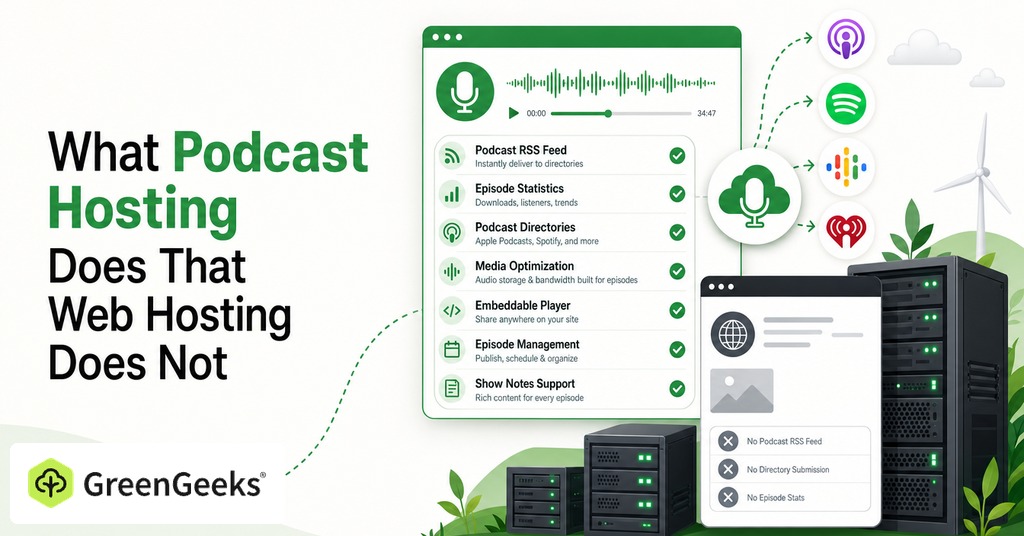

A weekly hour-long episode at 128 kbps is 57.6 MB. A show serving it 1,000 times from the same shared account that runs the website puts 230 GB a month through a plan priced for text and images, and the arrangement survives about two months before the transfer total outgrows the plan.
Audio belongs at a media host for technical reasons before commercial ones, and the website belongs on hosting the publisher controls. That means paying for two products instead of one rather than running the audio through a plan that cannot serve it.
What Podcast Hosting Does That Web Hosting Does Not
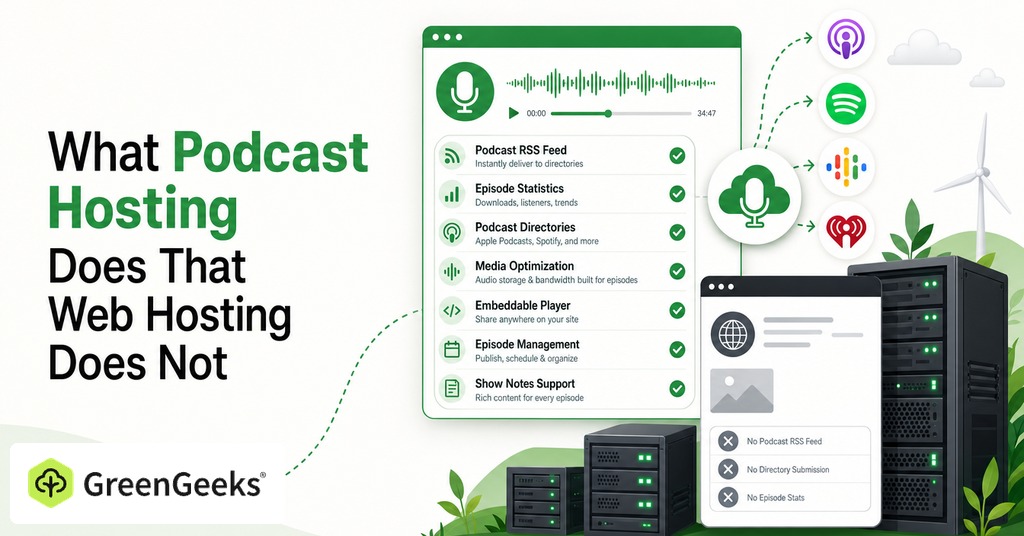
Both products use the word hosting for unrelated problems, and the confusion only costs money in one direction. A media host stores the audio file, serves it from a CDN, generates the canonical RSS feed and counts downloads against the industry measurement rules. It rewrites the stream when an ad is inserted, and it handles the redirect after a move between hosts. A web host serves HTML pages to browsers and nothing heavier than an image.

Apple’s podcast requirements specify the server behavior a feed depends on, telling publishers to enable the hosting server for HTTP HEAD requests and byte-range requests so that streaming playback works at all. Byte-range support lets a listener drag the scrubber to the 34-minute mark without the player pulling the file from byte zero, and it restores playback after a phone call interrupts it. A shared plan’s feature list says nothing about whether the origin answers a range request correctly, and the symptom when it does not is a listener who stops finishing episodes.
Dynamic ad insertion is the other capability with no shared-hosting equivalent. It requires the server to assemble a different audio stream for every request. A static file on a web server returns the same bytes to everybody.
How Much Bandwidth Does a Podcast Use Per Month?
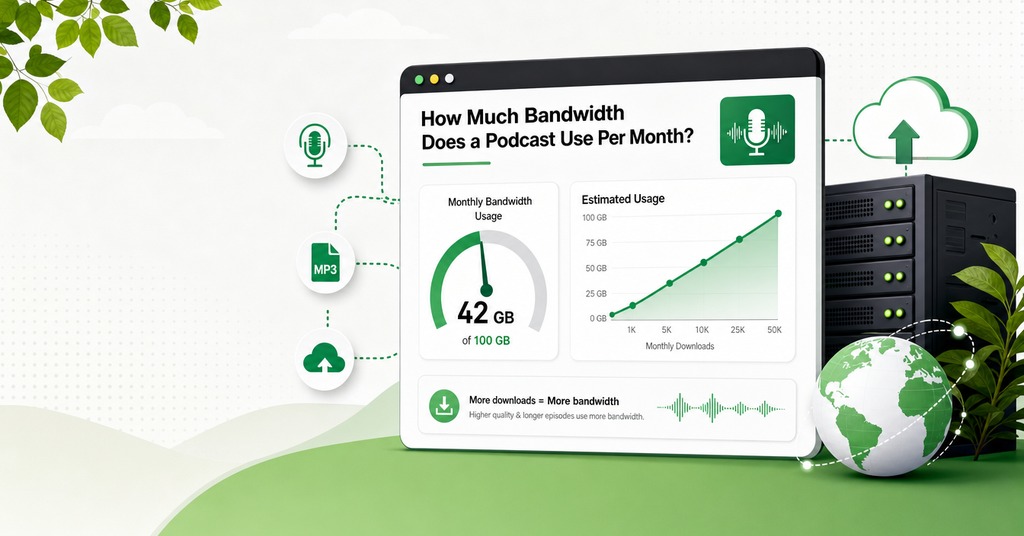
The monthly transfer figure is file size multiplied by downloads, summed across every episode in the feed and not only the one published this month, and it is worth estimating before the audio is committed to a host.
How Big Is a Podcast Episode File?
File size is bitrate multiplied by duration. Channel count makes no difference to the result. A 64 kbps mono file and a 64 kbps stereo file are identical on disk, and the mono version spends its whole budget on one channel, which is why mono at 64 sounds close to 128 kbps stereo on a talk show.
Bitrate
30 min
45 min
60 min
90 min
120 min
64 kbps
14.4 MB
21.6 MB
28.8 MB
43.2 MB
57.6 MB
96 kbps
21.6 MB
32.4 MB
43.2 MB
64.8 MB
86.4 MB
128 kbps
28.8 MB
43.2 MB
57.6 MB
86.4 MB
115.2 MB
192 kbps
43.2 MB
64.8 MB
86.4 MB
129.6 MB
172.8 MB
256 kbps
57.6 MB
86.4 MB
115.2 MB
172.8 MB
230.4 MB
Apple recommends 64 to 128 kbps for mono and 128 to 256 kbps for stereo at 44.1 or 48 kHz, and it puts AAC ahead of MP3 because the container streams more efficiently and seeks more accurately. The practical consequence of picking a row in that table is arithmetic. An hour of conversation exported at 128 kbps stereo costs exactly twice the bandwidth of the same hour at 64 kbps mono, for a difference most listeners on earbuds will not hear.
How Much Bandwidth a New Show Uses
Four weekly episodes at 45 minutes and 64 kbps are 21.6 MB each, and at 100 downloads per episode inside the month the show transfers 8.6 GB. A five-episode launch pulling 417 downloads across podcast apps in its first two weeks is a similar figure, about 18 GB at 43 MB an episode. Neither total registers on a shared plan. That is why the arrangement looks fine at the start.
What a Weekly Show at 1,000 Downloads Transfers
The 230 GB named at the start is a weekly show at 60-minute episodes and 128 kbps, 57.6 MB each, against 1,000 downloads per episode in the release month. A 40-episode back catalog pulling 25 downloads apiece adds another 57.6 GB from episodes published years ago, for a monthly total of 288 GB, and the back-catalog portion is permanent. Re-encoding the same show at 64 kbps mono reduces that traffic to 144 GB.
Bandwidth for a Mid-Size Show at 5,000 Downloads
The average active show on Buzzsprout’s platform took 729 downloads a month in June 2026, so a show at 5,000 downloads per episode is a working show well above that average. A weekly 60-minute episode at 96 kbps is 43.2 MB, and at 5,000 downloads apiece that puts 864 GB through the account in a month before the back catalog is counted.
Storage matters at this volume as well. A weekly show at 43.2 MB an episode adds 2.2 GB a year permanently, and none of the archive can be deleted without breaking every enclosure URL already published.
What a Viral Episode Costs in Bandwidth
A spike is worth less than the download count suggests, because a show pushed in front of millions gets a large number of people pressing play and few of them finishing, and every transfer is billed at full file size whatever the listener does with it. Subscriber counts climb through a run in the Apple top three while completion rates fall away.
The show most exposed to that is the small one. At 50,000 downloads, a single 57.6 MB file is 2.88 TB arriving across days instead of weeks, and Podbean’s $79 video tier caps monthly bandwidth at 3 TB. A dedicated media host has a ceiling in that range, so the 8 GB-a-month show is where a picked-up episode does the most damage.
What Breaks on Shared Hosting on Release Day
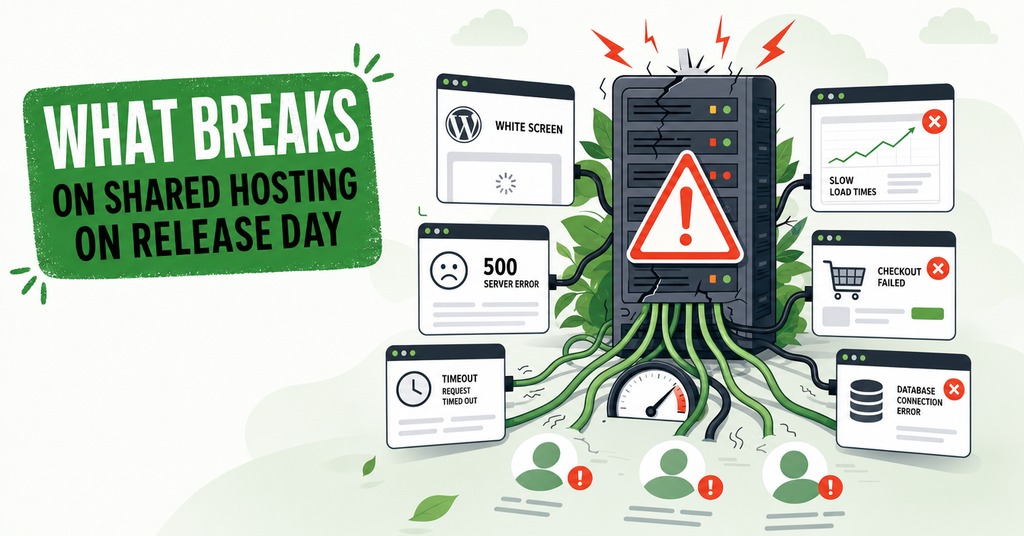
Publication puts hundreds of podcast apps on the origin inside the same few minutes, because every app caches the feed and polls it on a schedule that clusters around the release. An account tuned for short PHP requests then holds long-lived multi-megabyte transfers open, and the per-account process and connection caps start refusing connections while the monthly transfer total is still nowhere near the plan limit.
Feed polling adds a second load on top of the audio, since a daily show at 1.5 million monthly MP3 requests gets a parallel stream of hits on an XML file that every app which has ever subscribed keeps requesting. When the audio and the website share an origin, one machine takes both loads, so a traffic spike on the audio takes the website down and a WordPress problem takes the audio with it. Splitting the two means an outage on one side leaves the show in the directories on the other.
Podcast Download Analytics and IAB Certification
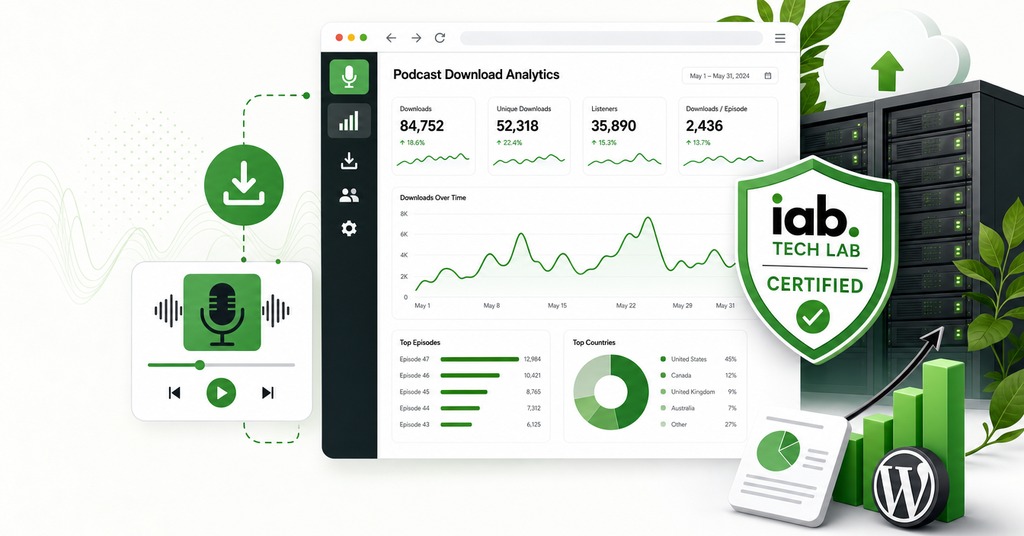
A web server access log records bytes and user agents without deduplicating them, and it applies none of the filtering rules the advertising industry uses. What comes out is a raw hit count that a sponsor has no reason to pay against, with no classification by app or by device.
IAB Tech Lab’s Podcast Measurement Technical Guidelines, currently version 2.2 from May 2024, describe how downloads are counted from server logs. Podcast episodes are transferred for later consumption and never held open on a live connection, so the counting has to work differently from web analytics. A separate compliance program lets hosts signal that they follow the rules, and Libsyn, Captivate and Spreaker all advertise certified analytics as a line item on their pricing pages. A self-run origin has no route to that certification, whatever the log parsing behind it.
Where Each Podcast File Should Live
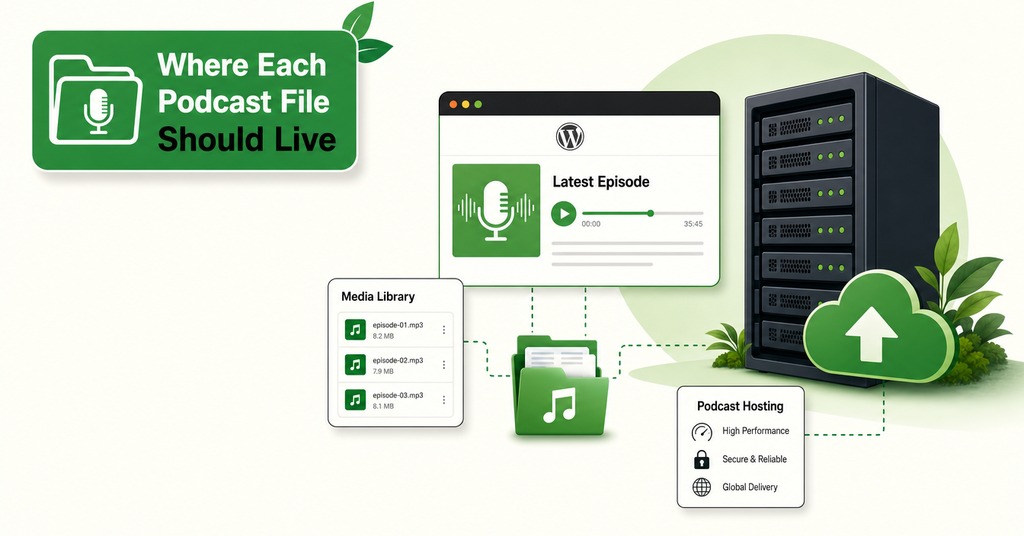
The audio file, the feed and the artwork URL are the media host’s problem, and everything a person reads belongs on the account the publisher pays for.
The Audio File and the RSS Feed
Both the audio and the feed that points at it are stored at the media host. Every episode in that feed needs its own enclosure element with a URL, a length and a type, and Apple ignores duplicate enclosure URLs without warning. Each episode also needs a globally unique identifier that never changes, and a plugin or a migration that regenerates identifiers republishes the entire catalog as new to every subscriber.
The remaining feed rules are narrow, and a media host applies them as a matter of course where a hand-rolled feed does not. Dates must be RFC 2822, so “Wed, 6 Jul 2014 13:00:00 -0700” passes where “7/6/2014 1:00:00 PM” fails. Category strings are case-sensitive, with “Kids & Family” accepted and “Kids & family” rejected, and filenames and URLs must be ASCII down to the quote entities.
Where Show Notes and Episode Pages Belong
Everything a human reads belongs on the publisher’s own web hosting. That covers episode pages, show notes, transcripts, guest bios, the contact form, the email capture and the sponsor kit. All of it is text and images measured in kilobytes, exactly what shared hosting was designed to serve.
A free platform that holds both the audio and the feed can remove a catalog in full over a copyright complaint against one episode, and the removal takes every enclosure URL with it, so there is nothing left to migrate and no warning beforehand. Six years and 168 episodes have gone that way over the music in a single show. Register the domain and the feed URL to the show itself and no platform can withdraw them. WordPress on a paid hosting account is one route to that, and daily backups included on GreenGeeks shared plans turn a bad plugin update into a restore instead of an incident.
Transcripts, Artwork and Video
Artwork is referenced rather than stored, so its placement is a question of URL stability instead of disk space. The itunes:image tag is a URL, and the image file can be served from either host as long as that URL stays stable and ASCII. Transcripts are referenced in the same way, since the podcast:transcript element appears inside each item in the feed, takes a url and a type, and can appear more than once for different formats. Pointing it at a file on the show’s own site gets the same text indexed on the episode page, and pointing it at the media host removes the upkeep. Video is the newer line item and it follows the audio, because files an order of magnitude larger belong at the media host for the same reasons.
Podcast Hosting Prices in 2026
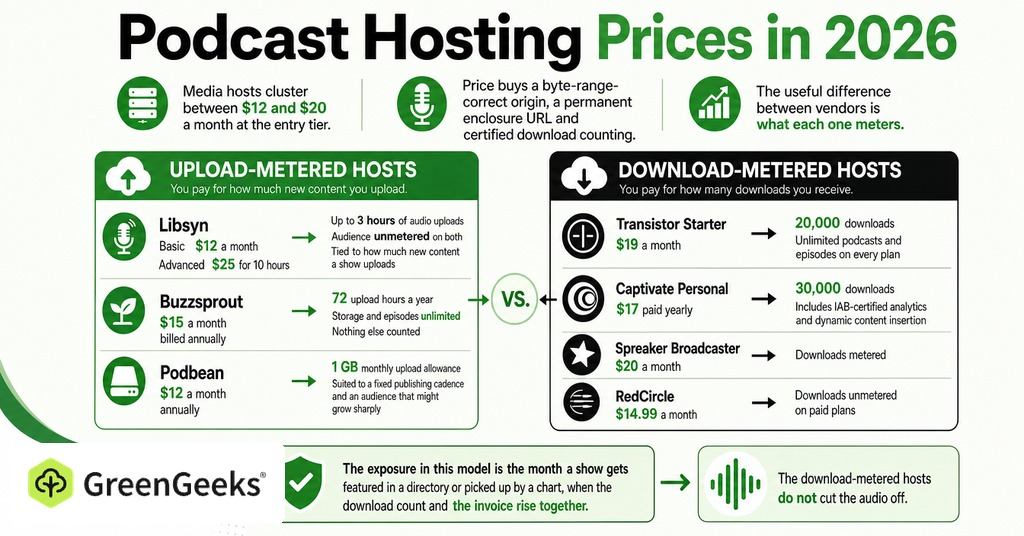
Media hosts cluster between $12 and $20 a month at the entry tier, and the price buys a byte-range-correct origin, a permanent enclosure URL and certified download counting. The useful difference between vendors is what each one meters.
Hosts That Charge by Upload Hours
Libsyn Basic is $12 a month for up to 3 hours of audio uploads, and Advanced is $25 for 10 hours, with the audience unmetered on both. The plan is tied to how much new content a show uploads rather than to its download numbers, so audience growth never produces a surprise invoice. At Buzzsprout the same logic costs $15 a month billed annually for 72 upload hours a year, with storage and episodes unlimited and nothing else counted. Podbean meters a monthly upload allowance in gigabytes instead, at $12 a month annually for 1 GB.
This model suits a show with a fixed publishing cadence and an audience that might grow sharply. A weekly 45-minute show uses 39 hours of upload a year and fits inside Buzzsprout’s 72-hour annual allowance with room to spare, which is the margin that disappears the moment a show adds bonus episodes or a second series.
Hosts That Charge by Monthly Downloads
The download-metered hosts price within a few dollars of each other at the entry tier. At $19 a month Transistor Starter allows 20,000 downloads, with unlimited podcasts and episodes on every plan. Captivate Personal costs $17 paid yearly for 30,000, and because it withholds no feature by tier, IAB-certified analytics and dynamic content insertion are included at that price. Spreaker’s Broadcaster tier is $20, and RedCircle goes the other way at $14.99 with downloads unmetered on paid plans.
The exposure in this model is the month a show gets featured in a directory or picked up by a chart, when the download count and the invoice rise together.
What Happens When You Go Over the Limit
The download-metered hosts do not cut the audio off at the limit. Transistor has no automatic shut-off and keeps serving audio to listeners while it makes contact, and Captivate lets the podcast keep running, reaching out only after a second consecutive month over the allowance. Upload-metered hosts handle the overage on the invoice instead, so Buzzsprout bills extra upload time on the next monthly invoice, while annual plans have a fixed number of hours and require an upgrade.
Is Self-Hosting Your Podcast Worth It?
The case for self-hosting is a price argument before it is anything else. A shared plan under $50 a year with a one-click installer, plus open-source publishing software like Castopod, does cost less than the $12 to $20 a month a podcast host bills.
The saving is smaller than it looks once maintenance is counted. Keeping a plugin stack and an open-source publishing install patched, monitored and migrated takes hours every month, poor value against $10 to $20 saved. The technical gap is wider than the commercial one. A self-run origin cannot produce the certified counting or assemble a stream per request, and Castopod appears not to handle a fleet of shows and a network, a limit that binds anybody running more than one. Arguments on either side of the question end at the same ownership discipline, and both name free platform hosting as the larger risk.
What to Put in Podcast Show Notes
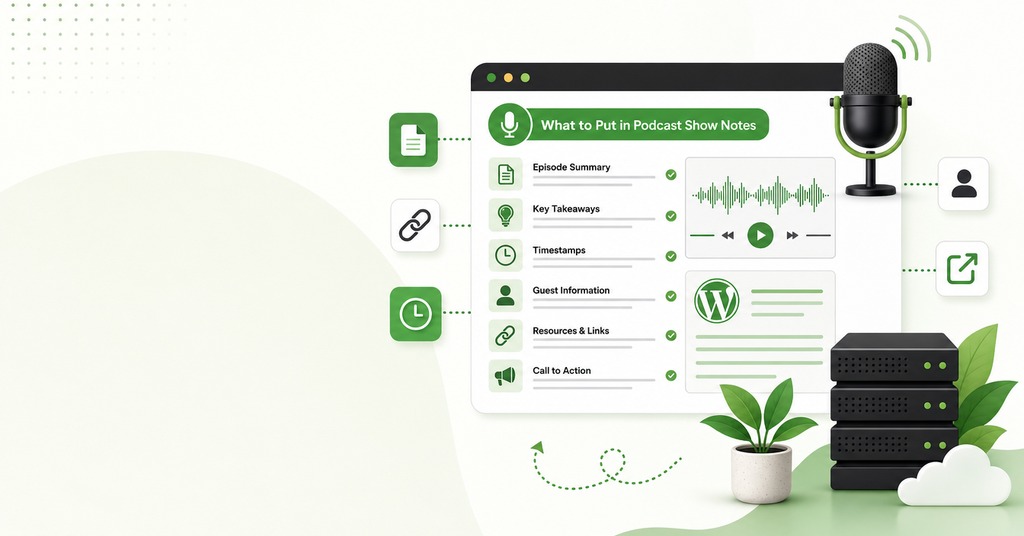
An episode page is the only part of a podcast that a search engine can read, and it is the part of the stack the publisher owns outright. Most of them waste the opportunity on an embedded player and three sentences. The structure that works puts the target phrase in the title tag, the H1, the URL and the first 100 words. Under that, open with a summary of less than 100 words, add a short guest introduction that does not give away the episode’s conclusion, then timestamped topics and a link to every resource mentioned in the episode.
Titles matter more than the page copy in one specific way. A Harry Potter show ranked 93rd in Apple Podcasts search for its own topic renamed itself from “Swish and Flick” to “Swish and Flick: A Harry Potter Podcast” and moved to 15th. Other factors may have been at work, and one rename is not a study. Naming the subject in the show title costs nothing and describes the show to a search box that has no other information.
Do Podcast Transcripts Help SEO?
A transcript makes an otherwise text-free page indexable, and that mechanism is settled while the ranking benefit is not, since no vendor-independent study shows that a transcript page ranks. Show-notes pages written to search best practice can take 33% of their views from organic search, a figure earned by written notes rather than by pasted transcript text.
A transcript no longer has to be bought or typed, since Apple Podcasts has generated them automatically since iOS 17.4, in 11 languages and across more than 170 countries, and most media hosts now emit the transcript tag. Buzzsprout generates transcripts for new episodes on all paid plans at no extra charge and puts them in the feed.
On an interview show the automatic transcripts are of limited use, since Apple does not label speakers and only a VTT file supplied by the publisher identifies every speaker line by line. Private feeds are not processed at all, leaving subscription shows to supply their own. The tag accepts five file types and Apple accepts two of them, VTT and SRT, so the file has to match the destination. Roughly 6.3 million of 164 million indexed episodes have a transcript.
Podcast Episode Page Schema Markup
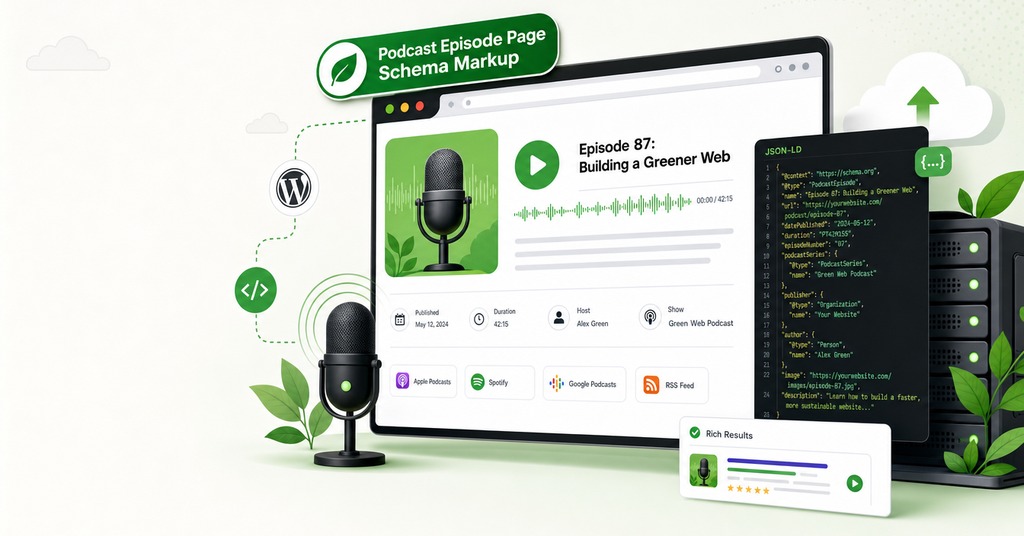
The one correct type for an episode page is schema.org/PodcastEpisode, and the fields worth filling on it are the ones a machine cannot infer from the page, which means episodeNumber, partOfSeries, duration in ISO 8601 form, datePublished and associatedMedia for the audio file. The type appears on 10,000 to 100,000 domains in Google’s index, thin adoption for a markup this old.
The property list promises more than the markup returns, since Google’s dedicated podcast structured-data documentation now returns a 404, consistent with the company having wound down its podcast search feature, and no rich result remains documented for the type. What is left in 2026 is an accurate description of the page for crawlers and for the answer engines that read structured data.
How to Set Up Podcast Hosting and a Website Together
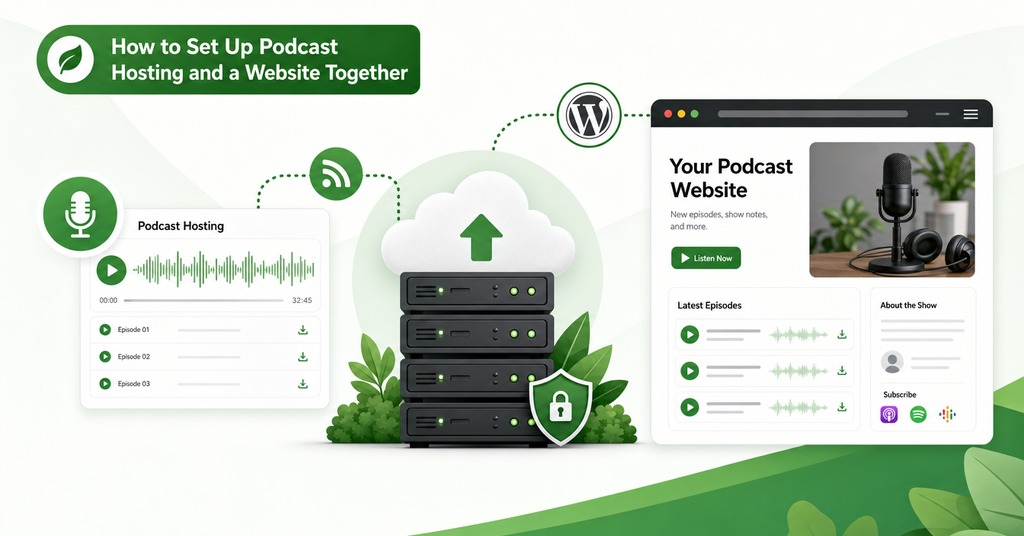
Start with the media host. The feed URL it issues becomes the show’s identity in every directory. Pick the metering model that matches the publishing cadence and the expected growth, publish one episode, then submit the feed to Apple and Spotify.
The domain comes second, and the website goes on a hosting account the show controls. On WordPress, Seriously Simple Podcasting and PowerPress are both maintained against the current release and both work with any media host. The ongoing cost of that route is double-entering episode metadata, unless the plugin syncs with the host. A builder that reads the feed and generates episode pages does the same job for around $12 a month, without a site to maintain.
Nothing should be allowed to regenerate the episode identifiers, and an old feed URL needs a 301 whenever the show moves hosts, since directories follow the redirect and subscribers follow the directories. Those two habits keep every other component in the stack replaceable later.
Frequently Asked Questions
What is the difference between podcast hosting and web hosting?
Podcast hosting stores the audio, serves it from a CDN, generates the RSS feed and counts downloads to industry standards. Web hosting serves the HTML of the show’s website. Apple’s byte-range requirement is the line between them.
Can I host my podcast on my own website?
Technically yes, and Apple allows feeds to be self-generated and self-hosted. The failure points are byte-range support, release-day concurrency, and certified download counting that no self-run origin produces.
Do I need a website for my podcast?
Not to publish, but it is the only part of the stack you own outright. If a platform removes the show, a site and a feed you control keep the audience reachable.
Can I use WordPress.com for a podcast website?
The hosted WordPress.com product is a restricted version of the software and may not permit basic player embeds. Self-hosted WordPress.org on your own web hosting is the route that supports the podcast plugins.
How much does podcast hosting cost in 2026?
Entry tiers cluster between $12 and $20 a month. Libsyn Basic is $12 for 3 upload hours at the low end and Spreaker Broadcaster is $20 at the high end, with RedCircle, Buzzsprout, Captivate and Transistor in between.
Is there free podcast hosting?
Yes, with conditions. Buzzsprout’s free tier allows 2 upload hours a month and deletes episodes after 90 days, and Spreaker’s free plan covers one podcast. The counter-argument is the long list of free hosts that have closed.
What tags are required in a podcast RSS feed?
RSS 2.0 compliance, the itunes and content namespace declarations, a unique enclosure per episode with URL, length and type, plus a permanent unchanging guid. The iTunes side needs itunes:image, itunes:category, itunes:explicit, itunes:author, itunes:title and itunes:type.
Why did my podcast feed fail validation?
The recurring causes are a date that is not RFC 2822, wrong category casing, or a non-ASCII character in a filename. Duplicate enclosure URLs are a fourth, and Apple ignores them without warning.
Does Apple Podcasts create transcripts automatically?
Yes, since iOS 17.4, in 11 languages and more than 170 countries. Apple generates them shortly after publication and labels them as automatically generated.
What is the best WordPress plugin for a podcast?
The two maintained options in 2026 are Seriously Simple Podcasting by Castos and PowerPress by Blubrry. Both are tested against current WordPress and neither locks you to a particular media host, and PowerPress implements the Podcasting 2.0 tags including transcripts.
How do I move my podcast to a new host without losing subscribers?
Set a 301 redirect on the old feed URL so directories follow it, and keep every episode identifier unchanged. Podbean, RedCircle, Buzzsprout, Captivate and Libsyn all provide free import and redirect tools.
What is the maximum podcast episode file size?
Apple Podcasts caps episode files at 512 MB, which at recommended bitrates only binds past roughly eight hours of audio. Transistor caps uploads at 1,000 MB.


