
AlmaLinux 9 VPS: When It’s the Right Pick

You’re about to make a big decision.
Maybe the biggest one of your life.
Okay, that’s a lie. But it is a decision that will live in your terminal for the next five years.
Which OS should you run on your new VPS?
You probably already know AlmaLinux 9 is a RHEL-family distribution, and you’ve heard it called “the modern CentOS.”
The question on the table is whether AlmaLinux 9 is the right answer for what you’re actually building, or whether Rocky, Oracle, Ubuntu, or Debian is the smarter call.
Most people pick the OS the first tutorial they read picked.
That’s how a Docker side project ends up on AlmaLinux when it should be on Ubuntu, and how a cPanel reseller ends up on Ubuntu when it should be on AlmaLinux.
But what’s right for you?
What Makes AlmaLinux 9 Different From Other Linux Distros?
AlmaLinux 9 is application-binary-interface (ABI) compatible with RHEL 9, governed by a non-profit foundation, and free forever. That’s the short version, and it’s how most readers will tell AlmaLinux 9 apart from the four distros it actually gets confused with.
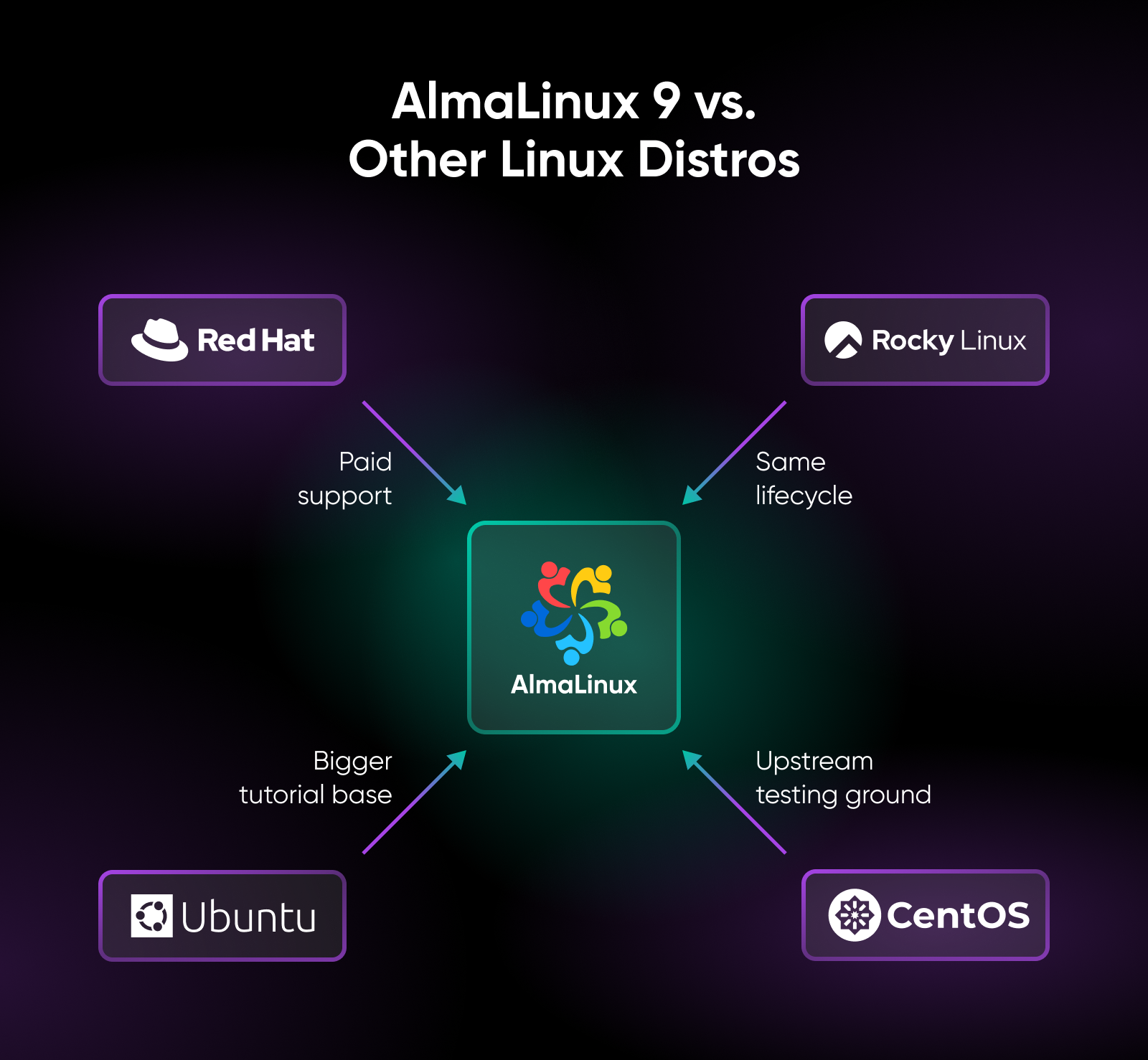
Here’s the longer cut, distro by distro.
AlmaLinux vs. CentOS Stream
CentOS Stream is the upstream development platform for RHEL, where Red Hat prepares code before release. AlmaLinux 9 no longer aims to be a 1:1 downstream rebuild of RHEL; as of July 2023 it maintains ABI (application binary interface) compatibility with RHEL 9, so RHEL-compatible applications run unchanged while the project keeps room to ship its own fixes.
AlmaLinux vs. Rocky Linux
Both projects launched in 2021 after Red Hat pivoted CentOS Linux into CentOS Stream. Both are RHEL-compatible. For most teams running a web server, database, or app server, the practical difference is negligible. Phoronix’s June 2025 benchmark review found AlmaLinux and Rocky performance “right on-par” with RHEL across dozens of tests, which tracks with every prior RHEL release.
The differentiators that matter live in governance. AlmaLinux’s governance sits inside the AlmaLinux OS Foundation, a 501(c)(6) non-profit with publicly available foundation bylaws. Rocky Linux has historically been closely associated with CIQ, one of its primary commercial backers.
After Red Hat made RHEL source code private in June 2023, AlmaLinux shifted from 1:1 binary compatibility to ABI compatibility. To adapt, it leaned on its open-source AlmaLinux Build System (ALBS), which it had already launched in July 2022, for transparent, reproducible package builds.
AlmaLinux vs. Ubuntu 24.04 LTS
AlmaLinux 9 fits long-running production servers and RHEL-adjacent ecosystems — if your team is already using CentOS, Red Hat, or Fedora elsewhere, the package management (dnf/rpm), SELinux defaults, and system administration patterns will feel familiar. Ubuntu 24.04 LTS fits modern dev workflows, Docker-first tutorials, and teams that want the larger community tutorial corpus. The package ecosystem (apt/deb) is different but not harder.
Support timelines are comparable: AlmaLinux 9 receives security patches through May 2032, and Ubuntu 24.04 LTS receives standard support through May 2029, with extended security maintenance available through 2034. The choice usually comes down to which ecosystem your team already knows.
AlmaLinux vs. RHEL
RHEL is the paid Red Hat product with a Red Hat support contract and access to channels like Red Hat Insights. AlmaLinux 9 is ABI-compatible with RHEL 9, free, and receives security patches through May 31, 2032, but without Red Hat’s commercial support contract.
For workloads that don’t need vendor support, AlmaLinux 9 offers a very similar operational experience without the per-system invoice.
Who Maintains AlmaLinux 9 and Can You Trust the Lifecycle?
AlmaLinux is maintained by the AlmaLinux OS Foundation, a 501(c)(6) non-profit founded March 30, 2021, with a community-elected board (up to 13 directors) and structural rules in its bylaws that prevent any single company from controlling the project.
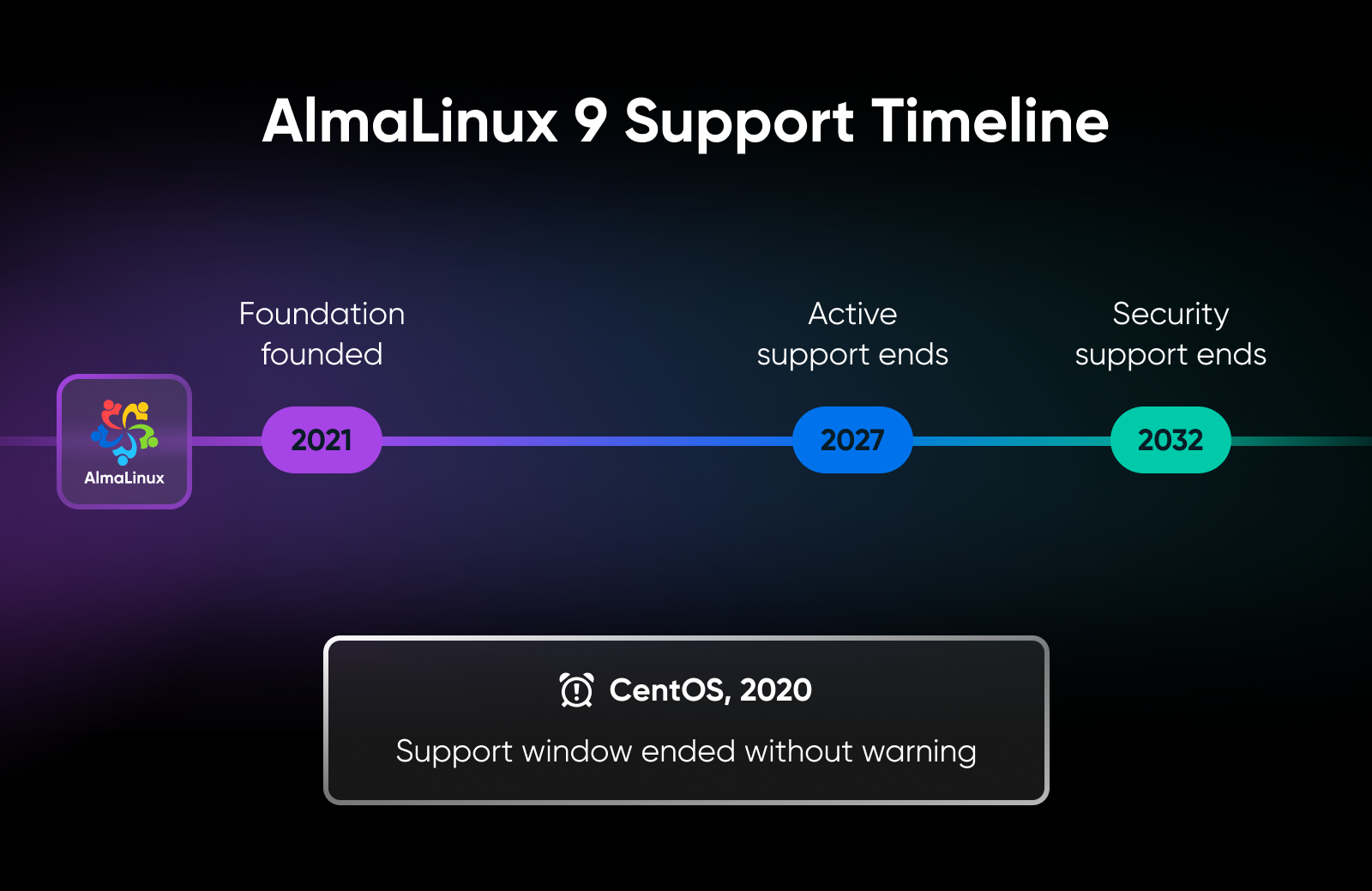
That’s the post-CentOS trust answer in one sentence. Here’s why it matters.
Platinum-tier sponsors — including CloudLinux — fund the Foundation alongside dozens of corporate members and a broad individual-member base (see the AlmaLinux Foundation membership page for the current roster).
Members elect the board, the bylaws are public, and the build system is open. The 2020 CentOS shift caught hosting teams flat-footed because a single corporate decision retired a distribution that thousands of servers ran on. AlmaLinux is structured so that the same thing can’t happen here without breaking the bylaws.
The lifecycle numbers reinforce that durability. Active support runs through May 31, 2027, and security support runs through May 31, 2032 (per endoflife.date). A 4 GB AlmaLinux 9 VPS provisioned today stays patched through roughly the full design lifespan of a midsize server deployment. (That’s not a typo. Six years from this article’s publication.)
For workloads where the cost of replatforming is high, the long tail is the entire point. You provision once, patch on autopilot, and stop thinking about the OS for years.
What Does AlmaLinux 9 Setup Look Like on a VPS?
A clean AlmaLinux 9 setup runs through seven moves. Nothing exotic — just a slightly different set of defaults than Ubuntu. The shape is the same as Ubuntu or Debian; the commands and a couple of defaults differ.
For the full command-by-command procedure, the AlmaLinux 9 installation guide is the canonical reference.
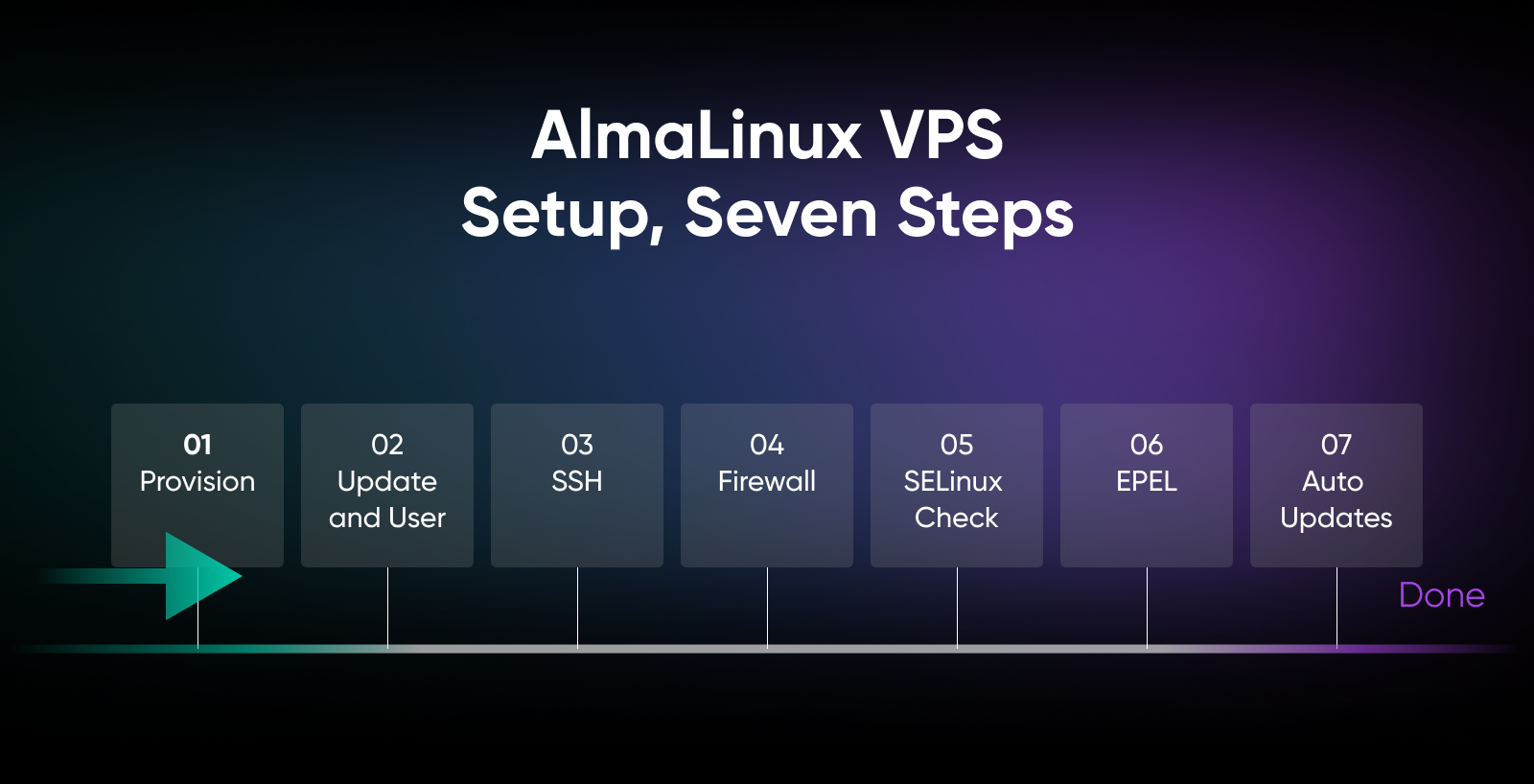
Provision the VPS with AlmaLinux 9 as the OS image
Many VPS providers ship a cloud image that boots cleanly on KVM hypervisors. Select AlmaLinux 9 as the OS image during provisioning, and confirm root access is enabled on the plan you picked — the rest of these steps assume you can sudo.
Update the system and create a non-root sudo user
`dnf update -y` is the AlmaLinux equivalent of `apt update && apt upgrade`. After that, create a dedicated sudo user and stop logging in as root.
dnf update -y
useradd -m -G wheel yourname
passwd yourname
(If your fingers still type ‘yum,’ you’re in good company. ‘dnf’ replaced ‘yum’ as the default package manager in RHEL 8-compatible distributions, though ‘yum’ still works as an alias to dnf on AlmaLinux 9.)
Harden SSH access
Switch to key-based authentication, set PermitRootLogin no in /etc/ssh/sshd_config, and restart sshd. The pattern is broadly similar to Ubuntu or Debian.
Configure firewalld
AlmaLinux 9 ships with ‘firewalld,’ the standard firewall management daemon on the RHEL family, instead of UFW. The command pattern is firewall-cmd –permanent –add-service=http, then firewall-cmd –reload.
Open 22 for SSH, 80 and 443 for web traffic, and avoid exposing unnecessary ports publicly.
Verify SELinux is enforcing
SELinux is Linux’s mandatory access control system, and AlmaLinux 9 ships with it set to enforcing by default. Run sestatus to confirm.
You’re looking for ‘Current mode: enforcing.’
Leave it that way.
Most RHEL-family software is packaged with SELinux contexts pre-defined, so the friction is generally lower than the reputation suggests. If a specific app fights SELinux, tune the context or policy instead of disabling SELinux entirely.
Enable EPEL
EPEL (Extra Packages for Enterprise Linux) is a Fedora Project repository for RHEL-compatible distributions that provides packages outside the base repos. On AlmaLinux 9, enable CRB first, then install EPEL, since most EPEL packages depend on it:
dnf config-manager –set-enabled crb
dnf install -y epel-release
Set up automatic security updates
dnf-automatic handles scheduled automatic package updates without rebooting the system unprompted. Turn it on once, and the 2032 security support window stays meaningful instead of decaying because nobody ran dnf update for nine months.
About 20 minutes of real work for someone who’s done it before. The first time costs more because firewall and SELinux conventions differ from the Ubuntu defaults most tutorials assume.
How Do You Size an AlmaLinux 9 VPS?
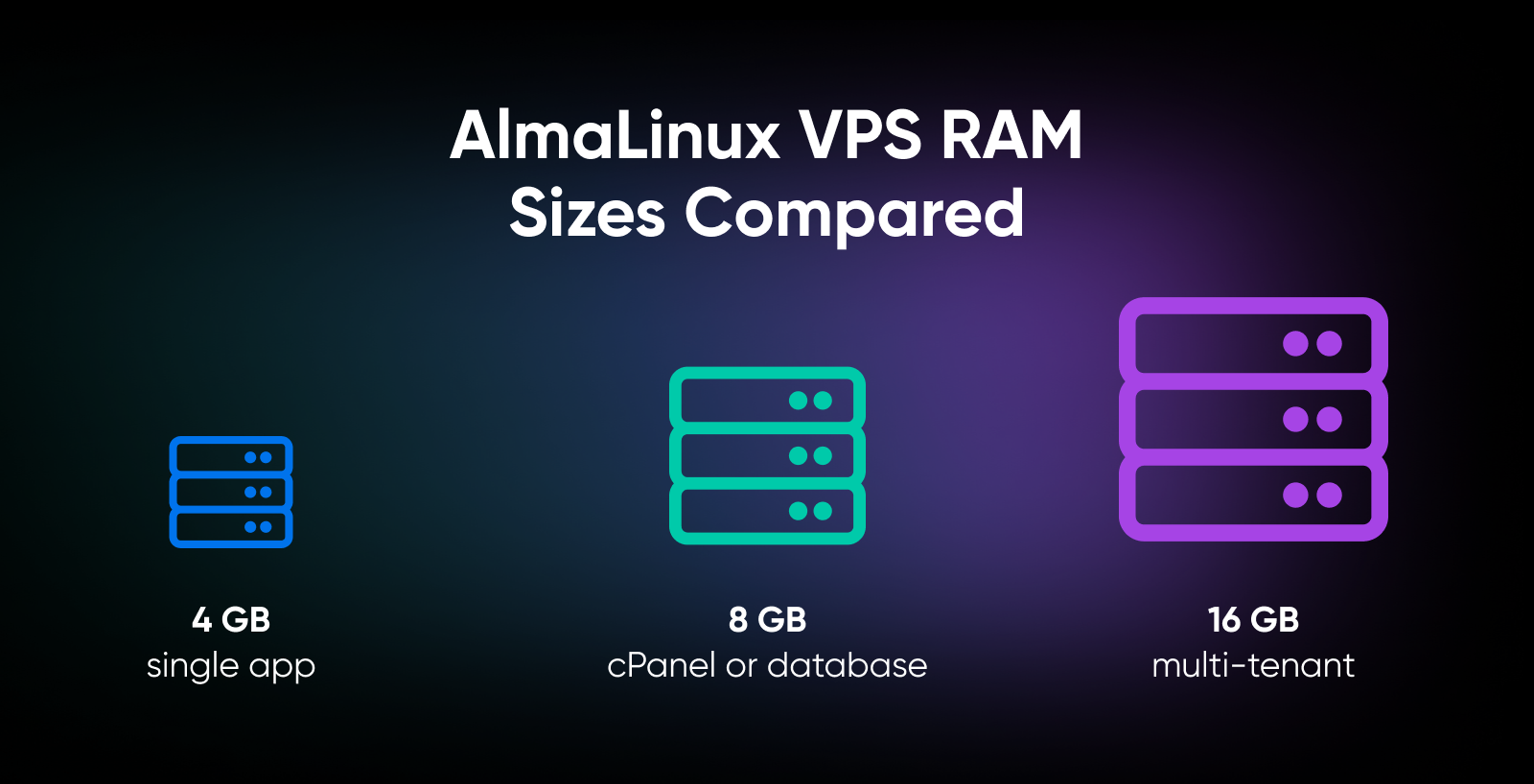
AlmaLinux 9 needs at least 1.5 GB of RAM for installation, 10 GB of disk space, and an x86_64-v2 CPU (roughly 2008-era Intel and 2011-era AMD processors and newer) per the official installation guide. The x86_64-v2 baseline is documented in the release notes. Anything above that floor depends on the workload running on top.
The realistic floor for a production server is 4 GB, and you’ll likely size up from there.
Here’s the practical mapping by workload:
You want a VPS with predictable pricing on those tiers, which matters more than people give it credit for. A surprise overage on a Linux server running a customer-facing app is the kind of thing that ruins a Friday just when you were about to grab a beer.
If you’re running PostgreSQL on a VPS with real production traffic, 8 GB of RAM is a more realistic starting point for many workloads, especially once concurrent connections, caching, and background jobs enter the picture.
Where Does AlmaLinux 9 Fit for Compliance Workloads?
AlmaLinux 9 is a low-cost way to achieve a RHEL-compatible security baseline for FedRAMP, HIPAA, PCI-DSS, and CIS-benchmarked workloads.
It inherits SELinux enforcing-by-default, AlmaLinux-documented FIPS 140-3 validation for specific AlmaLinux 9.2 crypto modules, and OpenSCAP compliance tooling from the RHEL 9 lineage.
- SELinux enforcing by default: Mandatory access control out of the box, with contexts pre-defined for most RHEL-family software. Auditors don’t have to ask whether MAC is enabled. The answer is yes.
- FIPS-validated cryptography: AlmaLinux 9 has documented FIPS 140-3 validation for AlmaLinux OS 9.2 crypto modules, but that validation is version- and module-specific, so teams should verify their exact AlmaLinux minor version and support path before making formal FIPS claims. Compliance environments that require FIPS-aligned cryptography can enable it without rebuilding the operating system from scratch.
- OpenSCAP profiles: AlmaLinux 9 ships with OpenSCAP profiles for HIPAA, PCI-DSS, and CIS benchmarks through AlmaLinux’s OpenSCAP guide for 9 and the ComplianceAsCode/OpenSCAP ecosystem. Run oscap against the profile, and you get a machine-readable audit report. Not a guarantee of compliance, but a serious head start on the technical control checklist.
- Vendor test-matrix coverage: Software vendors that certify against RHEL may also support AlmaLinux or other RHEL-compatible distributions, depending on the vendor’s policy. If a customer asks “do you support RHEL?” you can often develop and test against AlmaLinux 9 while reserving paid RHEL subscriptions for environments that require official vendor certification or support.
The other distros can be hardened to similar levels with effort. AlmaLinux 9 starts there.
When Should You Not Pick AlmaLinux 9?
Don’t be fooled, dear reader. AlmaLinux 9 is great. But it’s the wrong call for plenty of workloads.
Here are some disqualifiers:
- Your team is fluent in ‘apt’ and ‘ufw,’ and only ‘apt’ and ‘ufw’: The ‘dnf’ and ‘firewalld’ equivalents work fine, but the muscle memory shift costs time. Stick with Ubuntu or Debian if that’s the team you have.
- You deploy from Ubuntu-first tutorials: Many Docker tutorials, Node.js install scripts, and community guides default to Ubuntu 22.04 or 24.04. Translation errors are subtle.
- You need the newest package versions: AlmaLinux 9’s stability comes from holding versions steady across the lifecycle. If you want Python 3.13 the day it ships, Ubuntu’s release cadence and PPAs are friendlier.
- You’re running a Docker-first dev shop on rapid iteration: Ubuntu’s larger Docker base image ecosystem and community defaults are practical wins. SELinux policies and container labeling can add operational overhead when teams are iterating quickly, particularly compared with Ubuntu’s default AppArmor-based workflows.
- Your hardware predates 2008: AlmaLinux 9 requires x86_64-v2 — hardware predating November 2008 can run AlmaLinux 8 or move to a different distro.
DreamHost ships AlmaLinux 9 alongside Ubuntu LTS and Debian on a VPS. The right OS is whichever one your team can run without flinching.
Should You Run AlmaLinux 9 on Your Next VPS?
If your workload looks like RHEL, your team thinks like RHEL, or your auditor is going to ask whether the OS looks like RHEL, the answer is probably yes.
AlmaLinux 9 gives you a RHEL-compatible operational environment and a security support window that runs until May 31, 2032.
If your workload lives in ‘apt’-flavored tutorials and rapid Docker iteration, pick Ubuntu.
There’s no shame in matching the OS to the tutorials your team is actually going to follow.
So go back to that OS dropdown. You’re picking the Linux that fits this VPS, this team, this workload, this decade. Once you know which camp you’re in, the OS dropdown gets easy.

VPS
Own Your Entire Stack. Apps, AI, Databases, and More.
Keep every credential and conversation on a server you control, with NVMe speed and unmetered bandwidth built in.
Explore VPS Hosting Plans
Frequently Asked Questions About AlmaLinux 9 on a VPS
Is AlmaLinux 9 free?
Yes, AlmaLinux 9 is free. The distribution, security updates, and production use carry no license cost or per-server fee. It’s maintained by the non-profit AlmaLinux OS Foundation and funded by sponsors including CloudLinux, with governance published openly in the project’s transparency reports.
Is AlmaLinux 9 good for production?
Yes, AlmaLinux 9 is production-ready. The distribution is ABI-compatible with RHEL 9, ships with SELinux enforcing and firewalld on by default, and receives security updates through 2032. Cloud providers, control-panel vendors, and enterprise software publishers list AlmaLinux 9 as a supported platform.
AlmaLinux vs Rocky Linux, which one should I pick?
For most VPS workloads, AlmaLinux and Rocky Linux are interchangeable.
Both are free RHEL clones with the same lifecycle. Since mid-2023, AlmaLinux targets ABI compatibility while Rocky stays bug-for-bug compatible. Pick the one your team already knows; with no preference, AlmaLinux has broader hosting-provider image availability and a more diversified funding model.
Does cPanel support AlmaLinux 9?
Yes, cPanel supports AlmaLinux 9. cPanel and WHM run cleanly on AlmaLinux 8 and 9, and cPanel tests every release against the distribution and ships RPMs targeting it directly.
Plesk Obsidian 18.0.48 and later also support AlmaLinux 9.
How long is AlmaLinux 9 supported?
AlmaLinux 9 receives security updates and bug fixes through 2032, matching the RHEL 9 lifecycle. Plan a major version upgrade to AlmaLinux 10 (or its successor) before then. In-place upgrade tooling has historically followed each major release.
How do I migrate from CentOS Linux 7 to AlmaLinux 9?
Use the ELevate tool to migrate CentOS 7 to AlmaLinux 8, then run the standard upgrade path or a clean install to reach AlmaLinux 9.
CentOS Linux 7 reached end-of-life on June 30, 2024, so the migration isn’t optional anymore for internet-facing servers. Back up your data, plan a maintenance window, and verify each application after each version step.
Can I run Docker on AlmaLinux 9?
Docker runs cleanly on AlmaLinux 9 using Docker’s docker-ce repository configured for RHEL, thanks to binary compatibility, though Docker’s own docs officially list RHEL (not AlmaLinux) and note they don’t test derivatives. overlay2 remains the recommended storage driver. SELinux requires correct context configuration when containers need host-file access, but the Docker daemon handles common cases automatically.
How much RAM does an AlmaLinux 9 VPS need?
AlmaLinux 9’s documented minimum is 1.5 GB of RAM, but you’ll want at least 2 GB for any real workload. The realistic floor is 4 GB for cPanel or Plesk hosting and small production apps, and 8 GB or more for Docker, multi-tenant hosting, or a production database.
DreamHost’s VPS Stack 4 plan (4 GB) is a solid starting point for lightweight AlmaLinux 9 apps and solo projects, with Stack 8 or Stack 16 a better fit for cPanel/Plesk hosting or heavier production workloads.
Did you enjoy this article?
