
What It Takes To Get Sourced

Remember when ranking #1 on Google actually meant something?
You’d optimize pages, build backlinks, and traffic would flow. Page 1 meant visibility. The top 3 meant success. #1 meant you won the internet for that keyword. Those were simpler times.
Now you can rank #1 and still be invisible. That’s because Google’s AI Overview directly answers the questions users search, so users never scroll and never click.
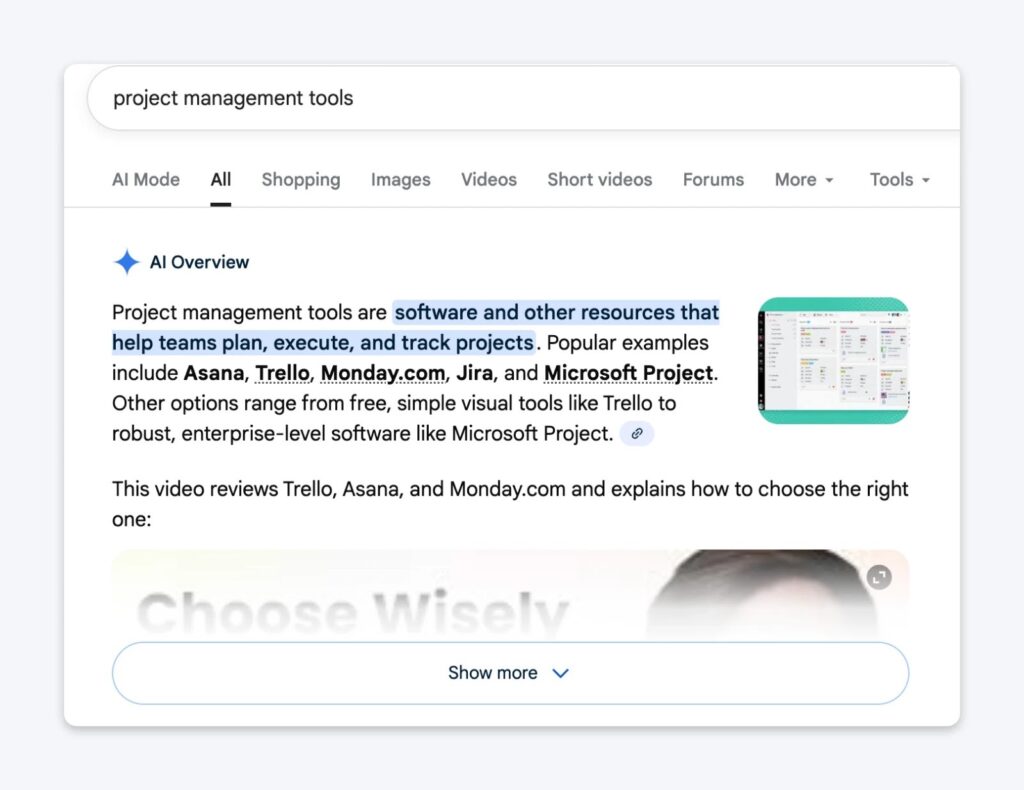
That’s the same with other AI platforms like ChatGPT, Perplexity, Claude, and so on.
Between January and October 2025, AI-referred sessions saw a jump of more than 100% compared to the same period before. These are visitors who arrived already convinced because AI recommended them.
If you have strong rankings, consistent expert content, and a solid content strategy, and yet — when someone asks ChatGPT about your expertise, you’re invisible — this guide is for you.
We covered generative engine optimization (GEO) basics and brand visibility tactics before. Now we’re talking about how to actually get cited.
Why Do Some Websites Get Referenced While Others Don’t?
Websites that get cited in AI search results balance three things: information quality, how easy that information is to access, and whether the overall website seems trustworthy.
So if you see competitors winning citations with content that’s arguably worse than yours, they typically have great technical infrastructure. We’re talking fast page speeds, strong backlinks, clean HTML, and other elements that make crawlers happy.
For instance, Perplexity may find multiple potential sources to cite for a question you asked. But the one that gets cited usually has a perfect balance between information quality, backlinks, and page speed.
If you have top-notch information quality but extremely slow page speeds, it’s unlikely that an AI crawler will stick around.
Research across 400+ domains shows the performance threshold clearly: sites loading under 2 seconds get cited 40% more often. Proper heading structure matters a lot. Fresh content updated within the last 30 days gets cited 3.2x more than stale pages.
These are the three technical problems that block great content from getting cited:
- Timeout limits eliminate slow servers before the platform even finishes checking your content.
- Messy HTML makes it hard to figure out what your main point is versus supporting details.
- Missing structured data forces platforms to guess what your content means instead of knowing for sure.
Strong on-page optimization accounts for about 77% of whether you get cited. Pages ranking in the top 10 on Google get cited way more often. The remaining 23% is what separates getting mentioned occasionally from becoming the go-to source.
How Do AI Models Decide What To Cite?
AI models decide what to cite using a framework we call the “Citation Readiness Stack.”
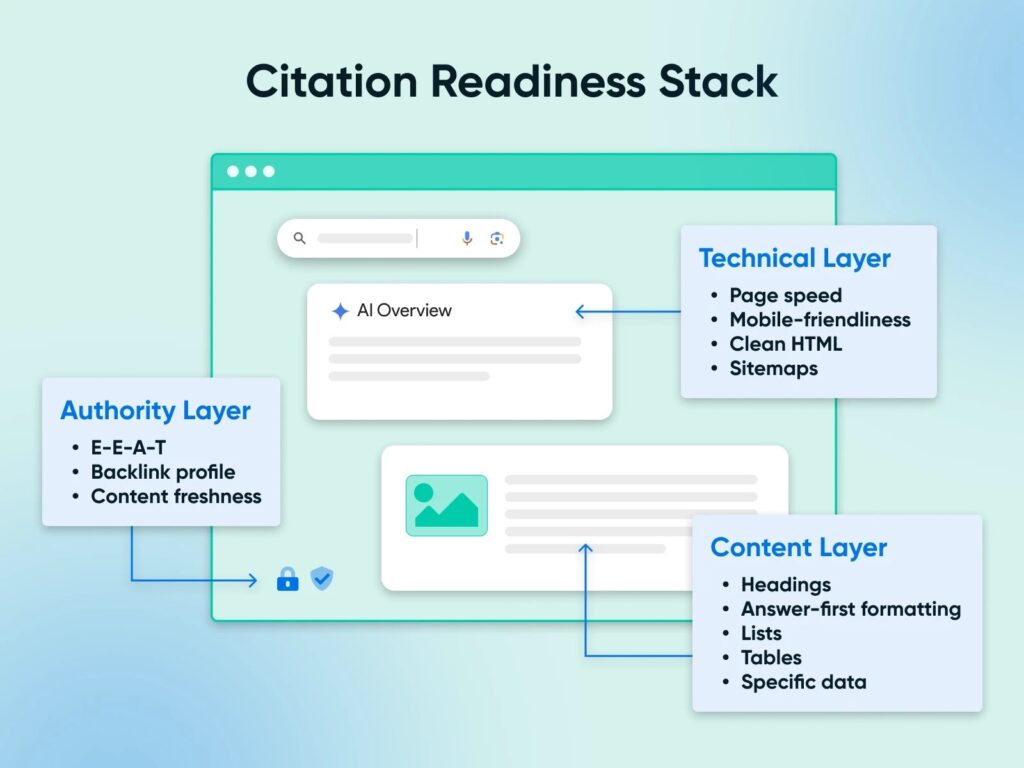
To win the citation, your site must be evaluated positively on all three layers:
Think of this stack like a pyramid. If the foundation is missing, the rest doesn’t matter.
- The Technical Layer (The foundation): This is the non-negotiable base. Can the AI crawler find, crawl, and parse your page quickly and efficiently? This layer is all about page speed, mobile-friendliness, clean HTML, and sitemaps. A failure here makes you invisible.
- The Content Layer (The substance): Once the AI is on your page, can it understand what you’re saying? Is your answer clear, complete, and easy to extract? This layer is about headings, “answer-first” formatting, lists, tables, and specific data.
- The Authority Layer (The trust): Finally, after accessing and understanding your content, the AI asks: “Should I believe this?” This is where it evaluates your site’s overall trustworthiness based on E-E-A-T (Experience, Expertise, Authoritativeness, Trustworthiness), backlink profile, and content freshness.
You must succeed on all three layers.
You can’t have a brilliant, authoritative article on a slow-as-molasses site. And you also can’t have a technically perfect site with thin, vague content. And you definitely can’t just have a fast site with great content that has no signals of authority.
Technical Layer: What Technical Optimizations Matter Most for AI?
The most critical technical factors for your “Citation Readiness Stack” are page speed, clean semantic HTML, and structured data (schema). AI crawlers have a limited “crawl budget” and processing power, so they will always favor sites that are fast, easy to parse, and explicitly tell them what the content is about.
This is the foundational layer. If you get this wrong, your brilliant content and high authority won’t matter because the AI will never get to them.
Entity Optimization
Entity optimization (also referred to as schema optimization) utilizes schema markup (or structured data). Schema markup is a type of code you add to your website that acts like a “nutrition label” for AI. It explicitly tells AI and search engines what your content is, removing all guesswork.
AI models are all about certainty. They don’t want to guess that your page is an article with a specific author, or that it contains a list of frequently asked questions. Schema markup lets you tell them for sure.
Proper schema implementation can increase reference probability by around 28%. That’s a massive competitive advantage.
You don’t need to be a developer to implement the basics. Here are the most important types:
- Article schema: This is the big one for content that tells AI the headline, the author, the publisher, the date published, and the date modified. This directly feeds the “Authority” layer by proving E-E-A-T and freshness.
- FAQ schema: This is gold for AI citations. You are literally spoon-feeding the AI a pre-formatted Question and Answer section. (Psst, our FAQ section at the end of this article uses it!)
- Organization schema: This establishes your brand as a recognized entity. It links your website to your company name, logo, and social profiles, building entity-level trust.
Here’s a basic Article schema example in the recommended JSON-LD format. You can add this to the <head> or <footer> of your page:
⚠️Do NOT misuse schema. Don’t put the FAQ schema on a page that doesn’t have FAQs. Don’t list information in your schema that isn’t visible to the user on the page. AI can detect this mismatch, and it will damage your trust, not enhance it.
Clean HTML
Most AI systems see your semantic HTML structure rather than plain text content. To make it as easy as possible for AI systems to read your content, you need to keep your HTML clean. You also want to maintain proper tag hierarchy for structure rather than just for the looks of it.
- You must have one (and only one) <h1> tag for your main title.
- Your subheadings must be in a logical, nested order: <h2>, then <h3>, then <h4>. Don’t skip levels (e.g., an <h2> followed by an <h4>) just for styling.
- Use <p> tags for paragraphs. Use <ul> or <ol> for lists.
This logical structure is how the AI parses your article. It’s how it tells the main point (the <h1>) from the key supporting topics (the <h2>s) and the specific details (the <h3>s and <p>s).
Messy, non-semantic HTML confuses the AI, and a confused AI will not cite you.
Content Layer: How To Make Content AI Citation-Ready?
You optimize your content layer by structuring it for extraction. This means formatting headings as questions, providing complete, data-backed answers “up front,” and using scannable lists, tables, and specific facts that an AI can easily pull from and present to a user.
This is the part you, as a content creator, have the most direct control over. The goal is to make your content as “AI-friendly” as possible without making it sound robotic. The best part is, the structure AI loves is the same structure that a busy, skimming human reader loves.
Write Headings Followed by Direct Answers
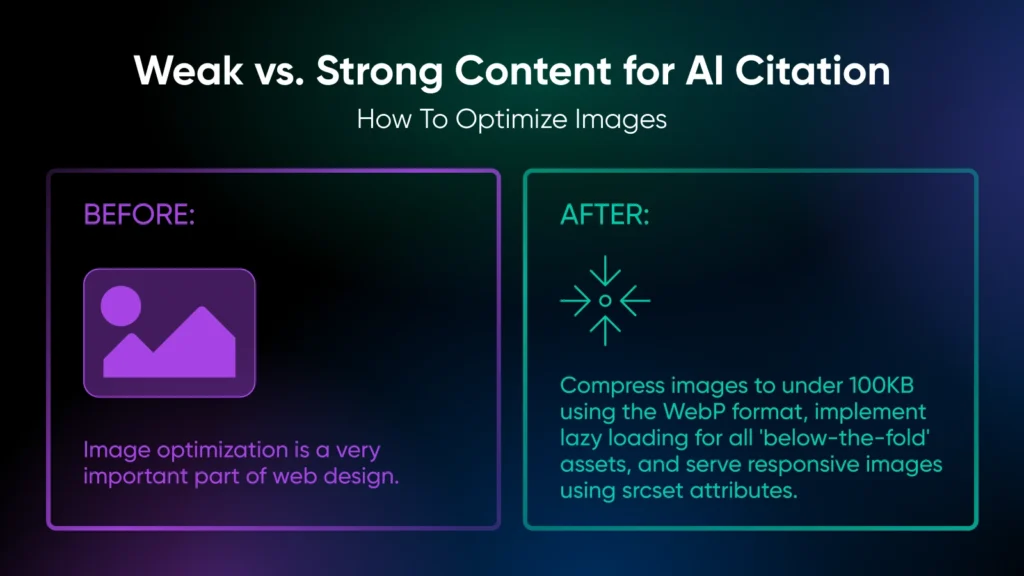
Format your H2s and H3s as the specific questions your audience asks (e.g., “How do I optimize images?”). Then, use the very first paragraph directly under that heading to provide a complete, direct, and specific answer to that question.
This is the “answer-first” or “inverted pyramid” model. Don’t waste time with a long, philosophical wind-up. Get to the point.
Here’s a clear example of the difference:
❌ Weak answer: “Image optimization is a very important part of web design. It involves several different techniques and approaches that can help improve your website’s performance on mobile devices through various methods. Let’s explore some of them.”
This answer says nothing. It’s full of filler words (“very important,” “different techniques,” “various methods”) and provides zero extractable value.
✅ Citation-ready answer: “Compress images to under 100KB using the WebP format, implement lazy loading for all ‘below-the-fold’ assets, and serve responsive images using srcset attributes. These three tactics are the fastest way to cut mobile load times by 40%-60% without any visible quality loss.”
This answer is a goldmine for AI, because it’s:
- Actionable: “Compress,” “implement,” “serve.”
- Specific: “under 100KB,” “WebP,” “lazy loading,” “srcset.”
- Data-backed: “40-60%.”
- Complete: A user could read just that paragraph and know exactly what to do.
An AI can confidently extract that second example and present it as the answer, citing your page as the source.
Use Lists, Data, and Original Research
AI models are synthesis engines. They are designed to find and present facts. When you use bulleted lists, numbered steps, and data tables, you make your content highly “extractable” because you’ve done the work of pre-formatting the facts for AI.
This is especially true for original data. Pages with original data tables get cited 4.1x more often. When you compile comparison charts, benchmark data, or research findings that don’t exist elsewhere, platforms recognize that unique value. It also dramatically improves your odds of driving qualified traffic to your website.
This works because you are providing unique value. If you’re the only source for a specific statistic or benchmark, the AI must cite you to provide that information.
Here’s how to apply this:
- Use numbered lists: Any time you describe a step-by-step process, use a numbered list.
- Use bullet points: Any time you list key features, benefits, or “killers,” use bullet points.
- Call out statistics: When you have a powerful number, make it bold. Don’t bury your 527% surge in the middle of a dense paragraph.
- Create tables: If you’re comparing products or features, use a simple HTML table. It’s the most extractable format for comparison data.
It also helps with scannability. Bullets break up your text, guide the reader’s eye, and make complex information easy to digest.
Authority Layer: How To Build “Authority” That AI Trusts?
You build authority, the top layer of the stack, by proving your E-E-A-T (Experience, Expertise, Authoritativeness, Trustworthiness) over time. This is achieved through three main signals that AI can measure: content freshness, a strong backlink profile, and clear authorship.
The authority layer separates you from a competitor who has also optimized their content and technical layers. It’s the final tie-breaker.
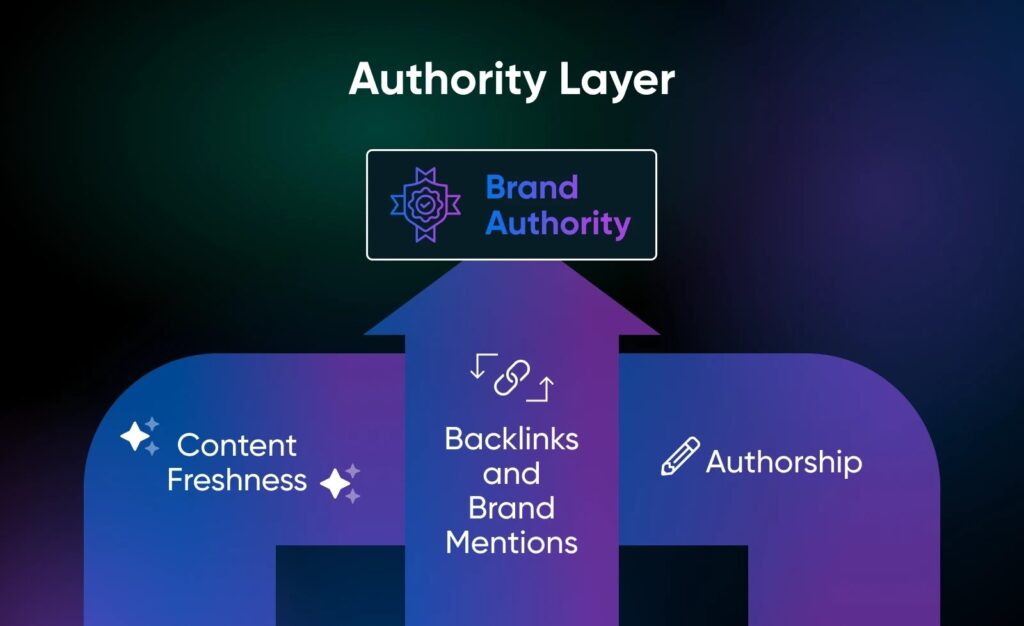
- Content freshness: AI, especially real-time search tools like Perplexity, loves fresh content. An article last updated in 2020 is a risky source. In fact, fresh content updated within the previous 30 days gets cited 3.2x more than stale pages. This doesn’t mean you have to publish new content every day. It does mean you should have a system to review, refresh, and re-publish your most important “cornerstone” articles with new data, examples, and a new “last modified” timestamp.
- Backlinks (authoritativeness): Backlinks are the web’s original trust signal, and they are still massively important. A backlink from a high-authority, relevant site (like a major university, news organization, or industry leader) is a powerful “vote of confidence.” It tells AI models that other trusted entities view you as an authority.
- Authorship (expertise and experience): AI models are increasingly trying to identify who wrote the content. This is a key part of E-E-A-T. You can signal this by:
- Using the Article schema to name your author
- Having a dedicated author bio page for that person, listing their credentials, experience, and links to their social profiles (like LinkedIn)
- Having that author write consistently on the same topic builds a clear pattern of expertise
Building authority takes time, and there are no shortcuts. But that’s exactly what makes your website the go-to source for topics around your niche once authority is built.
How To Prepare Your Website for AI Citations?
By now, you know what the Citation Readiness Stack is and can name the three layers, so it’s time to apply the learnings to your website.
Here’s a simple, 90-day plan that goes from low effort to high effort, helping your website get cited in AI search results.

This Week: Low Effort, High Impact
The most immediate gains come from refining your ten highest-value pages. This process starts with content clarity.
- Go through each page, rewriting the opening paragraphs under every heading to provide complete answers right away.
- Turn standard titles into questions, matching how people search, and replacing vague statements with specific examples or real numbers.
- While you’re editing, remember to update your publication dates and add “last updated” notes showing the content is current. These dates help AI platforms interpret your content as fresh for citation.
- You also need to communicate this with clarity. If you’re on WordPress, you can install an SEO plugin and call it a day. For non-WordPress websites, you need to work with JSON-LD. If you’re not comfortable with code, Google’s Structured Data Markup Helper can write it for you.
All these steps should take you no more than 30 minutes per page, and you can clear out 10-15 pages in a day all by yourself. If you have a team to help out, you can scale these efforts even further.
This Month: Moderate Effort, Big Results
With your core content optimized, the next priority is site performance and authority.
Start by addressing the performance problems identified in PageSpeed Insights, as slow-loading sites are often penalized. Here are some of the common first steps:
- Compressing images and converting them to WebP format
- Adding lazy loading for pictures that appear below the fold
- Minifying your CSS and JavaScript files
- Enabling browser caching for static files
- Upgrading your hosting if the server response time is over 600ms
Beyond technical speed, this month is about building deeper topic authority.
You can do this by constructing comprehensive FAQ pages for your main topics, each equipped with proper FAQ schema. Every question should target a specific search query you want to own, with answers kept complete but concise (usually 100-200 words).
This Quarter: Bigger Effort, Sustained Impact
Your foundation is now set for larger, long-term initiatives. The single most powerful way to gain citations is to create original research or compile unique data for your industry. This could involve surveying customers, analyzing product usage, or pulling together scattered information into comprehensive reports.
Submissions with original data are cited far more often than material that merely summarizes existing content.
On the technical front, it’s time to scale your structured data. Instead of adding schema manually, work with your development team to build it into your content management system (CMS) templates. This ensures all future content is automatically formatted correctly.
Finally, this work must be maintained. Set up a regular content review system that focuses on articles driving traffic or critical business goals. Evergreen content should be reviewed quarterly, while time-sensitive topics may need a monthly check-up to keep everything current.
This ongoing effort, combined with building relationships for natural backlinks, strengthens the authority signals that platforms rely on.
How To Track and Measure AI Citation Success?
Tracking AI citations requires a new approach, as the referral data is not always clean or consistent.
The best method is to combine referral traffic analysis in Google Analytics 4 (GA4) with manual, direct-query “spot-checking” in the AI tools themselves.
1. Check Your Analytics (The “What”)
In GA4, go to Reports > Acquisition > Traffic acquisition. In the “Session default channel grouping” report, look for traffic from new referral sources.
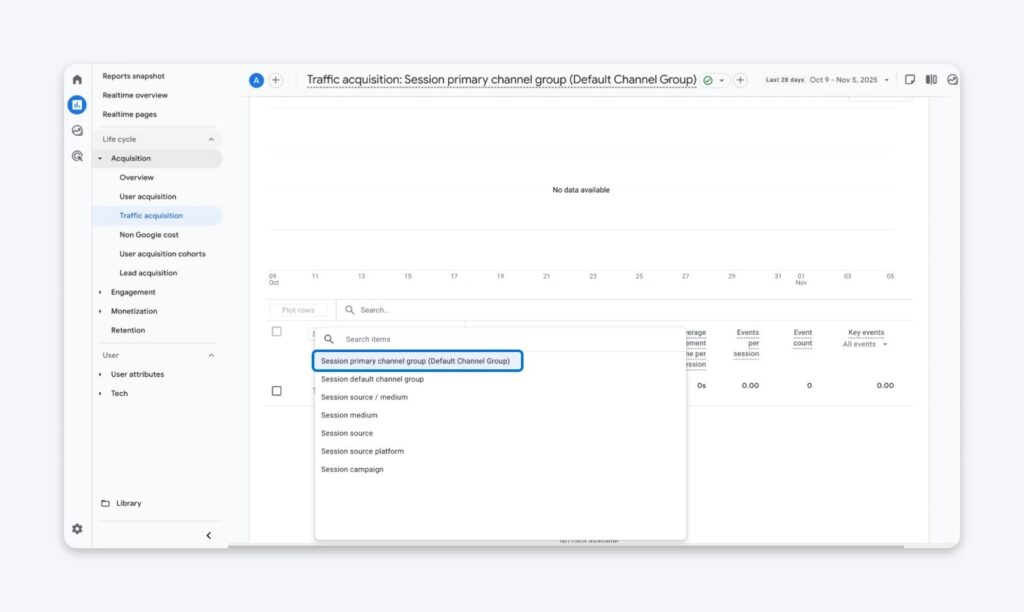
You may need to create a custom channel grouping for “AI Referrals” to track these domains:
- chat.openai.com
- perplexity.ai
- claude.ai
- gemini.google.com
- t.co (This can sometimes be AI-driven traffic, though it’s mostly X/Twitter)
2. Manual Spot-Checks (The “Why”)
This is the most important part, and it’s 100% manual.
Once a week, open ChatGPT, Perplexity, and Google (to check AI Overviews). Ask the exact questions your H2 headings are designed to answer.
- Do you get cited?
- Does your competitor get cited?
- If your competitor gets the nod, click through to their page. Run it through the 3-layer audit. What are they doing right that you aren’t? This is the new competitive analysis.
3. AI Citation Tracking Tools (When You’re Ready to Scale)
Once you’re seeing initial traction and want systematic tracking, specialized tools make life easier. The landscape exploded in 2025, so you’ve got options at different price points.
Budget-Friendly Starting Points
These solutions are perfect for small sites that are just getting started. They get the job done by tracking different queries related to your brand and reporting on your brand’s visibility.
- Otterly AI ($29/month) gives you automated reporting across major platforms. Great for agencies needing regular client updates without manual work. The catch: it tracks visibility but doesn’t help you fix problems.
- LLMrefs offers a free tier and $79/month pro plan with weekly tracking. Perfect for validating whether AI visibility matters for your business before committing to expensive tools.
Enterprise Options
The sites that we’ve come to rely on for SEO, also have AI trackers now. That’s why we put them in the enterprise options list. They have massive SEO data and can use that to better combine AI visibility reports with your search rankings for a more holistic view.
- Surfer AI Tracker ($95/month for 25-prompt blocks) launched in July 2025 with prompt-level insights and source transparency showing exactly which pages get cited. Early adopters praise having “a metric for AI visibility” after previously having no way to measure it.
- Semrush AI Toolkit ($99/month add-on per domain) analyzes how platforms like ChatGPT and Google perceive your brand, with sentiment analysis and market share metrics. Best for teams already deep in the Semrush ecosystem who want AI visibility alongside traditional SEO data.
- Ahrefs Brand Radar tracks mentions across ChatGPT, Perplexity, and Google AI Overviews using their massive 110 billion keyword database. Currently in beta and included with all paid Ahrefs plans ($129+/month), though it’ll eventually become a separate add-on. The interface needs work according to Ahrefs’ own CMO, but if you’re already using Ahrefs for SEO, adding AI tracking makes sense.
- Profound offers enterprise-grade tracking with keyword-style discovery where it suggests prompts you should track based on your site content. The platform combines traditional SEO analytics thinking with GEO tracking, potentially becoming the first GEO-first analytics tool that rivals Semrush and Ahrefs.
What Actually Matters Beyond Vanity Metrics
The traffic you get from AI platforms should be some of your highest-quality visitors. Someone asked a question, the AI pointed to you as the answer, they clicked. They’re pre-qualified and high-intent.
Look at these metrics for your AI referral segment:
- Session duration: Is it higher than your site’s average?
- Pages per session: Are they clicking around after reading?
- Conversion rate: Are they signing up, buying, or contacting you?
This is how you prove the value of this new traffic, not just the volume.
Become the Source AI Platforms Want To Cite
Getting cited by AI platforms is simple once you understand the full picture, but your success depends on these three factors:
Once you have these three things in place, all it takes is consistency. You consistently push new articles, new research, new social media posts, and so on.
Becoming citation-worthy does not require you to be the loudest of all competitors. Instead, you need to have deep subject knowledge and share it with extreme precision on all the right platforms. That’s the main pointer we’d like you to take away from this reading.

Pro Services – Marketing
Get More Visitors, Grow Your Business
The best-designed site is worthless if no one can find it. Leverage proven online marketing strategies and techniques to help more of your target audience find you.
See More
FAQs About AI Citation Optimization
Here are answers to the most common questions about optimizing your content for AI citations.
Does AI optimization hurt traditional search rankings?
No, it significantly helps traditional search performance.
The core requirements for AI citations include fast-loading sites, mobile-friendly design, clear answers to user questions, well-structured content, schema markup, and signals of expertise. These align perfectly with Google’s helpful content guidelines and core SEO best practices. Optimizing for AI citations means optimizing for both humans and search engines simultaneously.
Should content be written for AI or human readers?
Always write for human readers first. Your goal is to be clear, helpful, engaging, and to sound like a person. The GEO-Playbook structure (clear headings, answer-first, scannable lists) is not “writing for AI”; it’s a “human-first” design that respects the reader’s time. It just also happens to be the perfect, logical structure for AI to understand. Of course, if your content sounds robotic, you’ve gone too far.
Is AI citation optimization the same as GEO?
Yes, AI citation optimization is a core pillar of GEO. While traditional SEO focuses on “ranking” in a list of blue links, GEO focuses on becoming the source that is cited directly within the AI-generated answer. What we’ve outlined today is the practical, hands-on “how-to” for winning at GEO.
Did you enjoy this article?
